

9 October 2026
Submission: National Renewable Gas Policy
Executive Summary
Australia’s transition to net zero will rely on gas to continue to play an important role in Australia’s energy system for decades, supporting electricity reliability and meeting energy needs that are technically difficult, prohibitively expensive or inefficient to electrify. Decarbonising that gas demand remains an overarching challenge, while pursuing least-cost decarbonisation across the economy as a whole.
Renewable gases provide an opportunity to decarbonise gas use while taking advantage of Australia’s extensive existing gas infrastructure. Biomethane can substitute directly for natural gas and can be deployed using mature technologies, while renewable hydrogen offers a complementary longer-term pathway as its production, infrastructure and end-use technologies develop. Renewable gas should therefore be considered alongside electrification, energy efficiency and other technologies as part of a portfolio approach to decarbonisation, rather than as a competing or mutually exclusive pathway.
APGA recommends a coordinated policy package centred on a National Renewable Gas Target, supported by technology-neutral production incentives, fit-for-purpose certification, resolution of connection and first-mover barriers, and a clear domestic-market objective. Together, these reforms would provide the policy certainty required for biomethane to scale now, hydrogen to develop over time, and renewable gases to complement electrification in delivering a more reliable, flexible and least-cost pathway to net zero.
Australia needs a coordinated National Renewable Gas Policy
The central barrier to renewable gas deployment in Australia is thankfully no longer simply technological. Biomethane production is mature internationally and there is significant recoverable Australian biomethane potential. However, projects continue to face challenges establishing reliable feedstock supply chains, securing long-term offtake, financing production and upgrading facilities, and connecting to existing gas infrastructure. Renewable hydrogen faces further technical and economic challenges, but has potentially important future applications, including converting renewable electricity into a storable gaseous energy carrier as renewable generation expands.
Existing policy does not provide the certainty required for these markets to develop at scale. An enduring policy framework is necessary for these technologies to compete and develop according to their relative costs, capabilities and value to consumers and the broader energy system.
APGA urges the Commonwealth to establish a National Renewable Gas Policy which is nationally coordinated and technology-agnostic, joins other jurisdictions such as NSW in recognising renewable gas as a legitimate pathway to net zero, and provides both demand and supply-side support to establish a domestic renewable gas market.
A Renewable Gas Target should provide the demand signal
At the centre of this framework should be a National Renewable Gas Target (RGT). Modelled on the Renewable Energy Target that underpinned investment in renewable electricity, an RGT would create the durable demand signal necessary for renewable gas producers to invest with greater confidence.
The Federal Government has itself recognised the value of a durable demand signal in developing its proposed mechanism for low-carbon liquid fuels. Renewable gases face many of the same early-market problems, including uncertain demand, dispersed feedstocks, infrastructure requirements and difficulty securing investment before markets reach scale. There is a strong case for applying the same policy logic to renewable gas.
Policy must address the whole renewable gas supply chain
An RGT cannot operate effectively in isolation. Australia also needs fit-for-purpose certification and emissions accounting arrangements that permit renewable gas to be produced, traded and claimed by Australian consumers. Current renewable gas certification frameworks are imperfect and need reconfiguration to underpin a national renewable gas market. The certification framework should enable certificates to operate efficiently across the domestic market, including for households as well as commercial and industrial customers, while maintaining robust emissions integrity.
Supply-side incentives must similarly become technology neutral. APGA recommends extending appropriate existing renewable hydrogen support mechanisms to biomethane. The proposed Domestic Gas Reservation Scheme also provides an opportunity to encourage new renewable gas production through a carefully calibrated renewable gas multiplier, provided additionality can be demonstrated and the mechanism principally supports domestic emissions reduction.
Domestic decarbonisation should come first
Above all, a National Renewable Gas Policy should prioritise development of a domestic renewable gas market and the decarbonisation of Australian gas consumers. Australia has existing industrial, commercial and residential gas demand that must progressively decarbonise on the pathway to net zero. Renewable gas provides an opportunity to meet part of that challenge domestically while retaining the value of existing infrastructure, supporting Australian industry and developing new domestic supply chains.
Export opportunities can and should remain available, particularly where they assist projects to achieve commercial scale. However, they should be additional to, rather than substitute for, development of domestic demand. Public policy support should principally help Australian renewable gas production contribute to Australian emissions reduction.
Role of gas and renewable gas in the energy transition
Gas has a clear and enduring role in the transition to a net-zero economy
AEMO’s Integrated Systems Plan (ISP), while reflecting only the energy needed to support the National Electricity Market, makes this case starkly and consistently: gas will be needed beyond 2050 to provide a flexible supply of energy for the NEM that can outlast extended solar and wind droughts, and provide other system services including firming and shaping. The 2026 ISP forecasts 17 GW of flexible gas-powered generation will be needed by 2050, adding to and progressively replacing all of today’s 4 GW mid-merit and much of today’s 8 GW peaking gas-powered generation capacity as they reach end-of-life.[1]
Beyond electricity generation, gas will be a supportive pillar of the economy well beyond 2045, remaining essential for households, businesses and industry. While gas use in the economy is declining, AEMO’s Gas Statement of Opportunities – which is both an input into, and uses modelling from, the ISP – still forecasts north of 200 PJs per annum of natural gas will still be necessary beyond 2045, depending on scenario.[2]
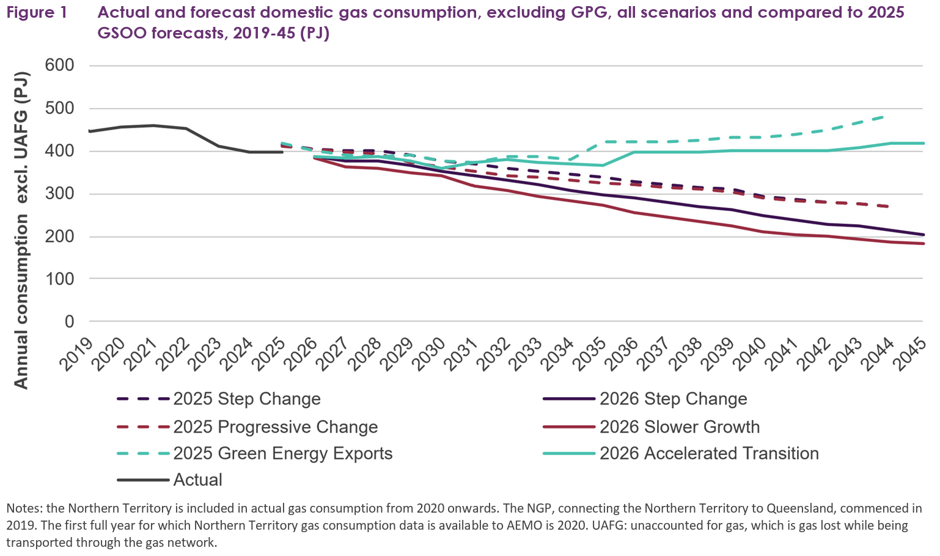
In a net zero economy much of today’s gas use must be decarbonised. Much of this energy demand can and currently is being decarbonised through switching to electricity as electricity generation becomes more dominated by renewables towards 2050. But in the meantime, electrifying gas use – particularly household and commercial gas use – is not necessarily the best option for all current gas use, even when electrifying is a viable pathway.
In 2023, APGA commissioned Boston Consulting Group (BCG) to consider the role of gas in Australia's energy transition.[3] Amongst its findings, BCG determined that the highest-value near-term use of additional renewable electricity is displacing coal-fired generation, particularly where this also enables decarbonisation across the economy over time, while placing commensurate value on the role of gas transmission and distribution networks in the Australian economy.
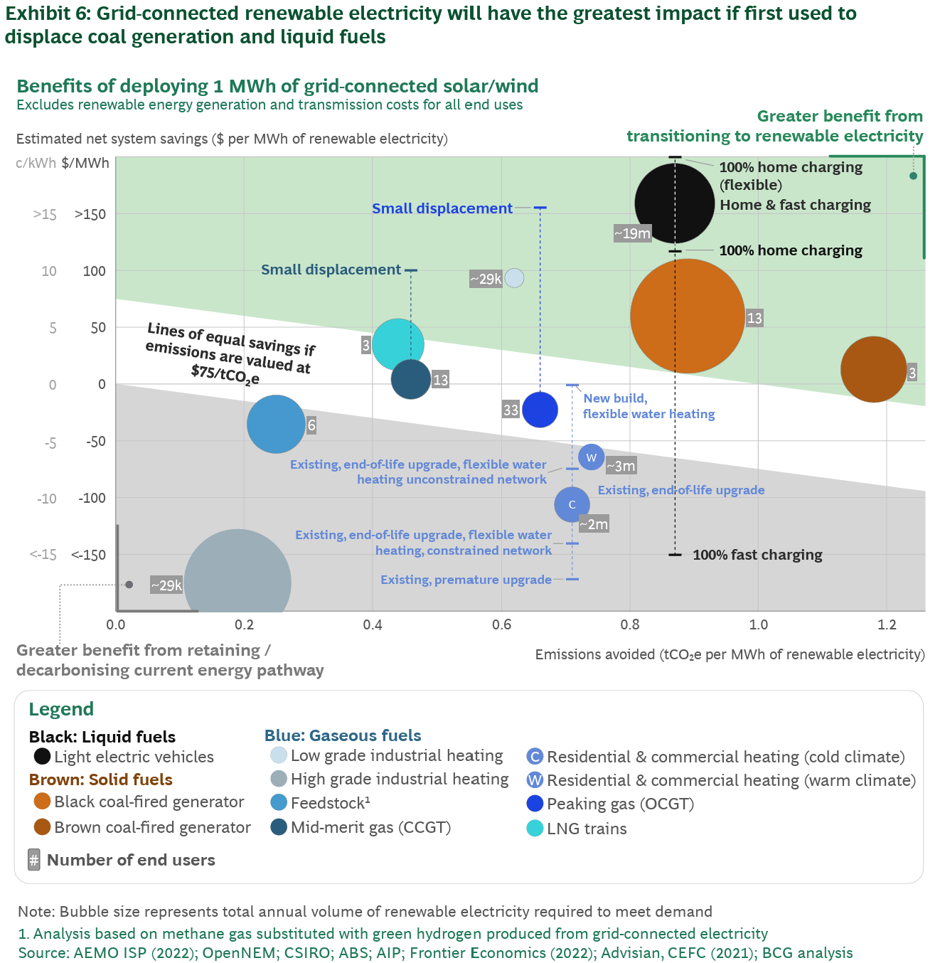
Assuming the current finite renewable electricity capacity is refocussed on displacing coal-fired electricity generation, natural gas use must still be decarbonised, particularly for “hard-to-abate” gas use which is commonly understood to be sectors for which emissions abatement is technically complicated, prohibitively costly, or would impose significant strain on energy infrastructure if done at scale.
Defining “hard-to-abate” industries or sectors is challenging, as the difficulty of the abatement task for any given use or industry depends on technical, economic and practical circumstances at the customer, facility or process level. No one definition will accurately encompass all “hard-to-abate” areas, especially where electrification is relied on as a proxy. This is important in Australia’s policy context, where “hard-to-electrify” is used as a proxy for “hard-to-abate” and includes much of heavy industry (e.g. metals, cement, chemicals), manufacturing processes requiring continuous high heat or using gas as a feedstock, and segments of the building sector.[4]
However, demand for energy that can be electrified leaves out an entire category of “hard-to-abate”, which are users who rely on gas fuels as a source of carbon. Many of these users will maintain reliance on gas indefinitely, as it is a necessary chemical component or feedstock for processes or products.
For all such “hard-to-abate” gas uses, and more broadly for the economy where having an alternative option is desirable, renewable gases can provide an alternative decarbonisation solution alongside efficiency and electrification measures. This also means that any demand-side policy needs to preserve broad access to a national renewable gas market across all consumers who may value a renewable gas option for decarbonisation and to ensure that the potential demand pool is not unnecessarily narrowed.
Decarbonising gas use with renewable gas
Renewable gases can decarbonise industrial thermal needs that electricity cannot easily reach. For example, manufacturers of glass, bricks, fertilisers, and pharmaceuticals currently rely on natural gas for process heat or feedstock – energy uses where alternatives are limited.
Biomethane, as a drop-in replacement for natural gas, yields an immediate reduction in scope 1 emissions without disrupting production methods. In the long term, renewable hydrogen can provide the necessary energy for industrial heat alongside biogenic CO2 for carbon. Industrial customers currently using coal or liquid fuels may choose to transition first to natural gas, then to renewable gas,[5] or move directly to renewable gas.
Beyond industrial gas use, more than five million Australian homes and hundreds of thousands of businesses use natural gas for heating, hot water, and cooking. Electrification of heating and cooking is occurring, but practical constraints exist: electrical upgrades to older buildings, managing winter peak electricity loads, and consumer preferences all pose challenges. Biomethane offers a drop-in decarbonisation option for the gas currently serving buildings, ensuring that residual gas demand in 2030 and beyond can be met with renewable content. This is especially valuable in colder regions or where building upgrades lag, as renewable gas can supply efficient instantaneous heat without additional grid burden.
The cost of the electrification alternative can be substantial and for many current gas users, unfinancial. And this cost spreads beyond individual costs, requiring substantial investment in electricity distribution networks. AEMO’s 2025 Electricity Network Options Report[6] estimates that the cost of unlocking additional network capacity rises quickly: about $400,000 per megawatt for local voltage optimisation, and around $2.4 million per megawatt when reinforcement is needed across low, medium and high voltage levels. The cost of electricity transmission infrastructure is not included in those figures.
Using renewable gas to ease electricity system pressure
One factor that is not readily appreciated is the way that gas decarbonisation through renewable gas can reduce projected bulk electricity needs. This means avoiding “gold-plating” of electricity assets, where poles and wires are built to meet peak loads that could instead be met more efficiently through renewable gases. International experience underscores this: UK studies have shown that attempting to electrify all heating would require enormous grid expansion yet still leave challenges in meeting carbon budgets, whereas a portfolio including green gases reduces both cost and risk.
This is relevant in the context of dramatic growth in electricity demand from both new loads and from household electrification. Data centres represent a dramatic new demand source, with the 2026 Electricity Statement of Opportunities estimating data centre demand will represent 10% of total NEM demand by 2050.[7] This is despite a stated (though not, at the time of the ESOO, legislated) intent for data centres to ‘bring their own renewable energy’.
In households, the push to electrify (including household appliances and private vehicles) has had uneven impacts on electricity demand. In Victoria, electricity distributor CitiPower observed that household customers who electrified their houses in 2024 more than doubled their average electricity consumption and nearly quadruples it in winter.[8]
Importantly, this represents electrification that took place ahead the Victorian Government’s policy that new residential and commercial properties, and a large number of existing properties, be all-electric from 2027. While there are exemptions, it is likely that there will be another surge in local electricity demand, not all of which will be offset by homeowner solar and battery installations. It is also electrification that took place before the 2026 surge in EV uptake.
Instead of electrification being the sole pathway for residential, commercial and much of industrial demand, renewable gases can offer an alternative. Renewable gases injected into distribution networks can immediately reduce the emissions intensity of that network.
Issues and challenges in scaling up renewable gases
Biomethane
Biomethane presents the most immediate opportunity to begin scaling renewable gas in Australia. The underlying technologies are mature and well established internationally, and biomethane can operate as a direct substitute for natural gas within existing gas networks and end-use equipment.
Analysis by Blunomy for Energy Networks Australia in 2025[9] identified around 400 PJ per annum of recoverable biomethane potential from existing Australian feedstocks. For biomethane, establishing supply chains, commercial arrangements and market demand necessary to deploy it at scale are the key barriers, which can be readily overcome with coordinated government action under a National Renewable Gas Policy.
One of the major practical challenges is bringing sufficient feedstock together to underpin projects at commercial scale. Australia's biomethane resource is distributed across diverse waste streams including food and garden organics, cereal and other agricultural residues, livestock residues, horticultural residues and sugarcane industry wastes. A National Renewable Gas Policy must create a framework for reliable feedstock supply chains that can gather geographically dispersed material and aggregate it into reliable, long-term supply arrangements and matched efficiently with production facilities and gas infrastructure.
Hydrogen
While more technically challenging, renewable hydrogen should also feature in this policy. Compared to biomethane, hydrogen is not a direct drop-in replacement for renewable gas, although it can be blended safely at various concentrations depending on the physical makeup of the distribution and transmission infrastructure.
Because of this, renewable hydrogen likely to follow a different development trajectory than biomethane, and its role may also evolve alongside the electricity system. In particular, renewable hydrogen provides a means of converting renewable electricity into a gaseous energy carrier, potentially creating an additional storage option for renewable electricity as the electricity system increasingly experiences periods of abundant generation.
Cost
The cost of renewable gases is also factor. While the end product cost is difficult to quantify given existing offtake agreements commercial in confidence, both biomethane and green hydrogen are currently much more expensive than the current wholesale cost of gas. Ignoring that renewable electricity was once much more expensive than the coal-fired power it is now rapidly displacing, renewable gas costs are often used to justify a focus on electrification, especially where the cost of biomethane and hydrogen as a product is compared to the cost of unabated natural gas.
Cost comparisons also need to reflect the decarbonisation task that renewable gases are being asked to perform. This comparison risks understating the value of the emissions reduction it provides. Conceptually, the appropriate comparison is closer to the cost of natural gas plus the cost of addressing its associated emissions, including the relevant carbon or abatement cost where applicable.
In contexts where ACCUs are the relevant means of meeting an emissions liability or abatement obligation, this means considering the combined cost of natural gas and the ACCUs required to address those emissions, rather than natural gas alone. This also provides a more meaningful basis for comparing renewable gas with other decarbonisation options.
Connections to existing gas infrastructure
A further challenge for renewable gas development is the cost and complexity of connecting new production facilities to existing transmission and distribution infrastructure. Unlike conventional gas production, many renewable gas projects are relatively small and geographically dispersed, and their commercial viability can be particularly sensitive to the cost of the facilities required to inject gas safely into an existing network or pipeline.
The physical connection itself can require dedicated infrastructure to ensure that renewable gas entering a network satisfies the network's operating and gas-quality requirements. Addressing these issues consistently is important because renewable gas producers are often new participants in gas markets, and are not always aware of their rights and responsibilities in accessing existing infrastructure.
The APGA Code of Practice for Renewable Gas Connections[10] was developed specifically to address connection barriers and provide renewable gas producers and infrastructure service providers with a common understanding of the technical, safety and commercial requirements for connecting to existing infrastructure. It covers matters including gas quality, network capacity, pipeline infrastructure, metering, facility design and commercial arrangements.
Beyond the technical requirements lies an important cost-allocation question: who should pay for the infrastructure necessary to establish the connection? The AEMC uses a “mover pays” principle which places the connections cost squarely on the renewable gas producer requesting the connection. This however places the full cost of connection on the first producer can create a first-mover disadvantage where infrastructure installed for the initial project has capacity, capability or information value that can ultimately support subsequent renewable gas connections. In those circumstances, the first project may carry costs associated with opening up a renewable gas production region or establishing a new type of connection, while later projects potentially benefit from the infrastructure and experience already established.
A National Renewable Gas Policy therefore consider connection cost allocation and the first-mover problem alongside demand-side support, particularly where investment in a connection would enable multiple producers, aggregate dispersed renewable gas supply or provide enduring capacity from which later projects can benefit.
A national, technology-agnostic approach to renewable gas policy
APGA has consistently advocated for a nationally-coordinated approach to renewable gas policy. In the absence of a national policy, some jurisdictions have begun implementing their own schemes to support the development of renewable gas markets, particularly NSW with its Renewable Fuels Scheme. Victoria has proposed an Industrial Renewable Gas Guarantee, effectively a target by another name to support industrial gas users. Both these schemes suffer from policy fragmentation, a necessarily smaller pool of demand, and the lack of a strong signal sent by coordinated Federal action.
Particularly in the context of a demand signal, a consistent national framework would improve certificate liquidity across jurisdictions, support competition among more producers and avoid duplicative state-based policies. State-specific frameworks can then complement the national market where they address local priorities.
These schemes, and market participants including prospective renewable gas producers, have also not operated under policy certainty that renewable gases are a viable pathway to net zero for Australia. It is this certainty in establishing a credible alternative to electrification, and the underpinning policy such as a demand signal to achieve it, which can be provided through a National Renewable Gas Policy.
Demand signal required to drive investment
The Renewable Energy Target was arguably the single most successful policy intervention aimed to drive investment in renewable electricity in Australia. A similar policy for gas would provide a strong demand signal to significantly improve the current investment landscape for renewable gases – especially where it must compete against renewable electricity. Without it, projects struggle to secure finance for upgrading, injection and grid connection infrastructure.
As described earlier in this submission, renewable gases can be a cost-effective decarbonisation option alongside electrification, and for many commercial and industrial users would be the only viable decarbonisation option. A clear demand signal is needed to drive this for renewable gas.
The need for such a demand signal to drive investment was also recognised by the Federal Government in 2026 in consulting on a demand mechanism for low carbon liquid fuels:[11]
“Stakeholders across the supply chain have consistently indicated that a clear and durable demand signal is necessary to bring certainty to support LCLF uptake. While competitive markets can function efficiently, government action is justified to provide certainty, de-risk early investment and support the establishment of a domestic LCLF industry…A clear demand signal can help improve investment conditions in Australia and reduce barriers to the local use of Australia’s sustainability grown feedstocks.”
The consultation paper proposes a target-based demand mechanism, which first aims to develop the market through volumetric targets which then transition to carbon intensity-based benchmarks across the liquid fuels industry.
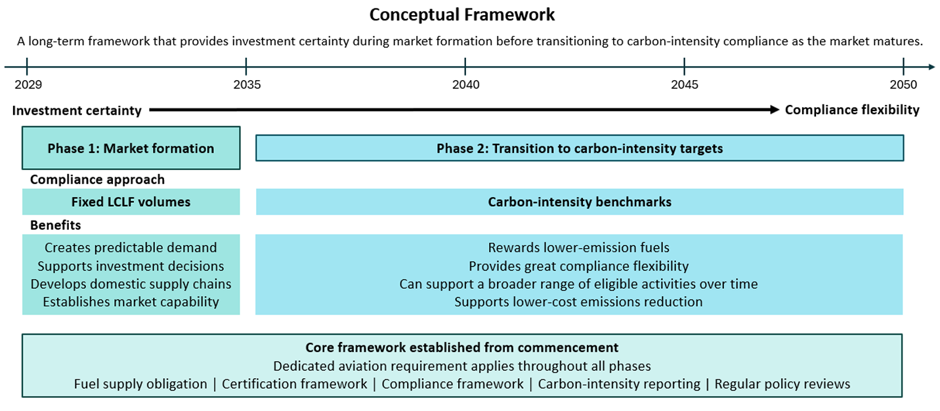
Many of the challenges presented by low carbon liquid fuels are equally applicable to biogenic renewable gases. Feedstock aggregation, connection to existing and new supply chains including transport options, and establishment of market capability are all barriers shared with the development of biomethane. A demand signal through a national target is one piece of the puzzle, but one functionally absent for renewable gases to date.
APGA notes that there is one state based scheme operation, with another in development: the NSW Renewable Fuel Scheme, and Victoria’s proposed Industrial Renewable Gas Guarantee. These are important schemes to help established early demand signals, but they are not necessarily equal; the Victorian scheme, for example, will target renewable gas only for industrial use, which necessarily limits the size of the potential market. A national scheme would avert some of these compatibility challenges and provide a consistent, coherent demand signal.
Implement a National Renewable Gas Target
To fully unlock the potential of renewable gases, Australia should implement a national Renewable Gas Target (RGT). This would be a demand-side policy mechanism modelled on the Renewable Energy Target that successfully expanded renewable electricity. Depending on the design, an RGT would set gradually increasing requirements for the volumetric share of gas sourced from renewable gases, or carbon intensity benchmarks, or both (as is proposed for LCLF). It would provide a guaranteed market and a clear investment signal.
In 2024 commissioned ACIL Allen to consider optimal policy trajectories for the rollout of renewable gases.[12] This work considered a range of options, including a certificate-backed target scheme, direct contracting, feed-in tariffs and direct grant funding. ACIL Allen key findings was that a certificate-based Renewable Gas Target was the least-cost policy option for achieving net zero and that under a national renewable gas target (the Optimal RGT scenario), the renewable gas industry can scale sufficiently to provide least-cost decarbonisation for a range of industries, especially with early roll-out of biomethane.
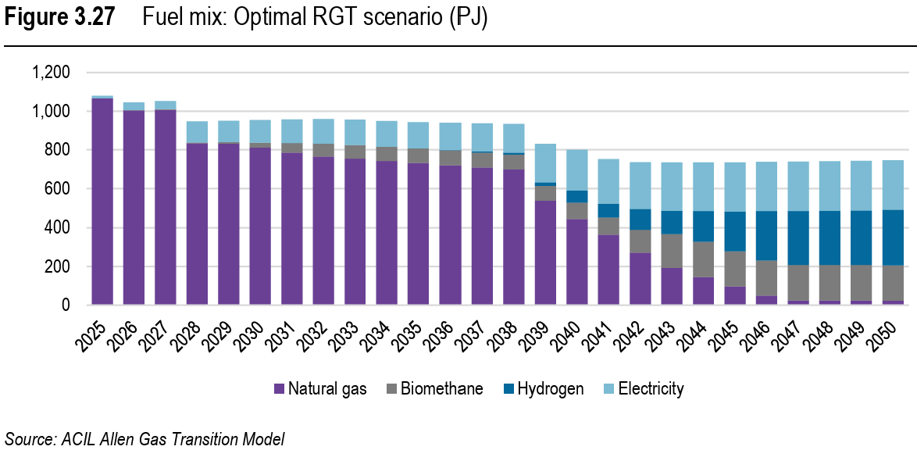
Even under ACIL Allen’s modelling Electrify Everything Possible scenario, there remains a meaningful role for gas energy, provided in this case by green hydrogen given the close relationship between renewable electricity production and hydrogen production through electrolysis:
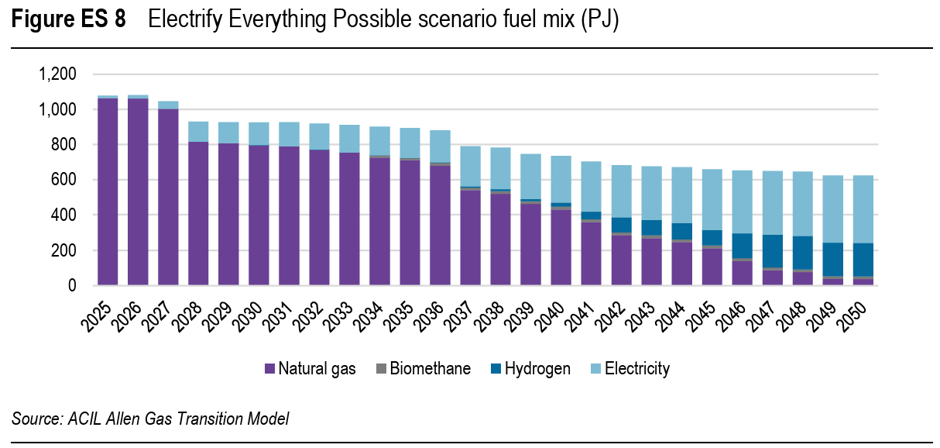
A cornerstone of the Optimal RGT scenario is a gradual and early build-up of renewable gas: around 3 per cent of consumption by 2030, 25 per cent by 2040, and 95 per cent by 2050. While modest in the early years, even a small obligation by 2030 would catalyse industry development in the long term. It would support project development, establish supply chains, and prepare the industry for large-scale deployment in the 2030s and 2040s.
Key to the success of the industry is an RGT that enables projects closest to commercial readiness to proceed first, without prescribing what the future makeup will look like. Due to technological readiness APGA does consider that biomethane projects are likely to make up the bulk of early renewable gas supply, but there are renewable hydrogen projects that can proceed earlier under the right market conditions. Both should be able to take advantage of a demand signal provided by an RGT.
ACIL Allen’s modelling does suggest that renewable hydrogen will be able to provide bulk energy once renewable electricity has scaled sufficiently to reliably need storage beyond what batteries can provide, closer to 2050. And in the near term, however, biomethane has significant advantages: it immediately scalable as a drop-in replacement for natural gas. Deploying biomethane in the 2020s and 2030s can deliver significant emissions cuts in parallel with electrification, effectively buying time for solutions like hydrogen to mature.
Like the Renewable Energy Target, an RGT could utilise a certificate trading scheme. Gas retailers and large users would be required to source a growing proportion of their supply from renewable gases or purchase Renewable Gas Certificates from accredited producers. This mechanism closes the cost gap between renewable and natural gas and creates a durable revenue stream for producers.
Domestic focus should be a priority
A National Renewable Gas Policy should ensure that certification, emissions accounting and any future demand-side mechanisms work together to enable Australian renewable gas production to contribute to Australia’s own decarbonisation objectives and support Australian gas users. Robust certification is also critical to the success of an RGT.
APGA has consistently advocated for a domestic focus for Australian renewable gas production and strongly recommends that a National Renewable Gas Policy prioritises the development and use of renewable gases in Australia, with domestic decarbonisation as its primary objective. Australia must decarbonise existing gas use across industry, businesses and households in the long term; this is the primary goal of developing a domestic renewable gas industry, with other factors such as digestate being a secondary benefit.
Renewable gases provide an opportunity to reduce emissions from existing demand while making use of established gas infrastructure, particularly where electrification is difficult or comparatively costly. APGA has previously argued that a Renewable Gas Target should prioritise domestic gas use and that national policy frameworks should support Australian gas customers rather than predominantly facilitate an export industry
A domestic focus is also important to create the demand certainty necessary to establish a viable Australian renewable gas market, and should extend to the design of the supporting regulatory architecture. This thread was particularly relevant to the development of the Guarantee of Origin (GO) Scheme, where APGA strongly argued that the original export-focused design of the scheme which simultaneously locked out domestic use while making it incompatible with international schemes. Our advocacy influenced the final design of the GO Scheme to one which is compatible with the operation of the domestic gas market.
APGA appreciates that export opportunities remain important and need not be excluded entirely from the policy framework, especially where it may assist in the financials of the initial scaling of the industry. However, export development should be additional to, rather than at the expense of, building a domestic renewable gas market. A National Renewable Gas Policy should prioritise establishing domestic demand, supporting investment and industry development, and ensuring that public policy directed towards renewable gases delivers benefits first within Australia.
Certification schemes must be fit for purpose
An RGT must be backed by a robust certification scheme. There are two broad streams for certification of renewable gases: GreenPower’s Renewable Gas Certification, and the Federal GO Scheme’s Product GO Certificates. GreenPower, as a program backed by the NSW Government, carries similar legitimacy to the GO Scheme, and both have benefits and flaws.
Product GO certification tracks hydrogen production throughout the supply chain, including through connected networks. Because its design requires a reasonable ‘physical connection’ (such as gas grids on the east coast), trading of certificates across all end users is limited. The scheme itself does not prescribe specific end users
GreenPower’s certificates, unlike Product GO certificates and like renewable electricity certificates, are entirely fungible. Disconnecting the emissions of the product from the consumed molecule allows much more flexibility and enables a genuine trading market for these certificates. GreenPower however does limit end users to industrial and commercial customers; households (even through a retailer) are a prohibited end use. This means that households pay for the renewable gas use of commercial and industrial purchasers, the emissions benefit of which they cannot receive.
Ultimately this means that neither scheme is completely fit for purpose for a national RGT. Relatively minor amendments, including the GO Scheme’s reasonable physical connection requirements and GreenPower’s end user prohibitions, would mean both schemes could support an RGT.
Other policy levers necessary to boost investment
On the other side of the supply-demand equation are policies and frameworks to encourage production. This has been the focus of the Federal Government to date, with incentive schemes including the Hydrogen Headstart fund and the Hydrogen Production Tax Incentive. Notably, these focus solely on green hydrogen, even though biomethane can be produced and deployed at lower cost.
Beyond capital funding and production incentives, there are other ways to support qualifying projects meet FID that have not been considered in renewable gas, such as feed-in tariffs or premiums, volumetric support, contracts for difference schemes, plus broader access to grants and concessional finance through Australian Renewable Energy Agency or the Clean Energy Finance Corporation.
Other indirectly relayed policy developments, specifically the Domestic Gas Reservation Scheme, offer an opportunity to provide a separate renewable gas supply incentive linked to the scheme.
Expand existing incentive schemes to biomethane
Expanding existing incentive program to include biomethane will enable biomethane and renewable hydrogen to be developed on equal footing and for the market to select the correct project for a given location and source of demand. These Funds should also ensure that a clear majority of supported projects support domestic decarbonisation, rather than entirely for export.
For Hydrogen Headstart, this would necessarily require a rescaling of eligibility thresholds (including facility size) given the differences in technologies and supply chains. Hydrogen Headstart was intended to push forward very large-scale developments earlier, arguably well ahead of the current market. Round one of the Fund will support the development of two 50MW electrolysers to supply hydrogen for the production of ammonia for fertiliser, much of which is intended to be exported, and hence not entirely linked to domestic decarbonisation. Round two of the fund dropped the minimum hydrogen electrolyser size to 30MW, which is still comparable to some of the largest electrolysers that have been developed globally and well larger than where the market is generally for hydrogen. The largest operating hydrogen electrolyser in Australia is AGIG’s 1.25MW electrolyser at its Hydrogen Park SA project.
The largest biomethane production facility in Australia, Jemena’s biomethane plant in Malabar, can currently produce 95 terajoules of renewable gas annually, and it is unlikely that facilities in Australia in the early stages of biomethane industry development will reach close to the largest facilities in Europe which can produce up to 1,500 TJ per annum. Conservative estimates of Australia’s biomethane potential is in the tens of petajoules per annum. Hence, eligibility requirements should be recalibrated to ensure they are appropriately sized for the market as it is in Australia currently and within the near future.
A biomethane stream for the Hydrogen Production Tax Incentive would also be transformational for biomethane producers. The tax incentive for hydrogen is set at $2/kg, which equates to approximately $14/gigajoule for biomethane – a significant incentive for investment. Biomethane from upgrading landfill gas would become available at a cost considerably lower than the current premium, making viable many currently marginal projects which produce biomethane from anaerobic digestion.
Beyond these funds, renewable gas should be recognised as a priority investment area under ARENA and the CEFC that enables project development and deployment, beyond “first of a kind” projects to which funding has been traditionally limited.
Renewable gas multiplier for the Domestic Gas Reservation Scheme
The concept of a ‘renewable gas multiplier’ or premium was introduced in the design draft of the Domestic Gas Reservation Scheme. APGA supported the concept of the multiplier in the scheme, noting that renewable gases are a potential compliance pathway where additionality is demonstrated. Eligibility should be technology neutral and capable of accommodating the range of gas types already recognised within the National Gas Law framework, including biomethane, hydrogen and synthetic methane.
APGA notes that the renewable gas industry remains at an early stage of development and currently faces cost challenges relative to conventional gas supply. These challenges may be exacerbated if the scheme places downward pressure on domestic gas prices. This highlights the importance of targeted and coordinated policy settings across the supply chain to support the commercialisation of renewable gas and enable it to compete over time.
In this context, carefully calibrated incentives can play a role in encouraging participation in the domestic renewable gas sector. Mechanisms such as multipliers applied to new renewable gas volumes used for compliance could support the development of additional supply, and ideally be directed to support Australian emissions reductions including Safeguard Mechanism compliance.
A scheme like a multiplier must operate under a coherent National Renewable Gas Policy. Decisions around the size of the multiplier, and the operation of the scheme, including whether there should be volumetric or temporal caps should be made with a view that it supports additional domestic renewable gas investment that underpins domestic decarbonisation first.
Consultation questions
|
Question |
APGA response |
|
Role of gas in the energy transition: a. Given that some sectors are expected to maintain reliance on gaseous fuels until alternatives are developed and deployed, should certain sectors (e.g. hard-to-abate industries) be given a higher priority or focus of a national renewable gas policy? If so, which sectors and why? |
While helping to decarbonise “hard-to-abate” sectors is one benefit of a robust renewable gas industry, a Renewable Gas Policy should not seek to restrict the product purely for these sectors. Firstly, defining “hard-to-abate” industries or sectors is challenging, as the difficulty of the abatement task for any given use or industry depends on technical, economic and practical circumstances at the customer, facility or process level – all of which are different for each user. This includes operating requirements, electricity capacity, logistical and practical complexity of the space, ownership arrangements and above all, costs.[13] No one definition will accurately encompass all “hard-to-abate” areas, especially where electrification is relied on as a proxy. Within “hard-to-abate” there are a category of users who rely on gas fuels not as a source of energy, but as a source of carbon. For these users the assumption that gas use is transitional “until alternatives are developed and deployed” is flawed. Some gas users will maintain reliance on gas indefinitely, as it is a necessary chemical component or feedstock for processes or products. Secondly, any move to restrict renewable gas end users (in this case, to “hard-to-abate” users) creates artificial scarcity. Achieving sufficient scale to provide an abundant supply of renewable gases is difficult to achieve with without a broad range of end consumers. Producers need access to sufficient customers to leverage common user transmission infrastructure such as distribution networks – and this may mean residential and commercial customers as well as industrial.
Policies should be aimed at scaling development of renewable bases towards abundance, rather than an assumption of scarcity. This will ensure that producers are always competing for customers, and that prices are set by the next highest cost producer rather than the next highest paying customer. A National Renewable Gas policy should support all gas users, whether or not they are considered “hard-to-abate,” to minimise the overall cost of reaching net zero. The Renewable Energy Target provides an example of how this has worked in practice: coupling the Target’s strong and broad demand signal with targeted supply signals (grants, feed-in tariffs, financing support) enabled the significant and relatively speedy scaling of renewable electricity generation. This is in part because a broad base of customers were able to directly access those emissions savings, including households and businesses. |
|
Focus on biomethane: a. Should the work on a national renewable gas policy focus on biomethane, or should other renewable gases, such as bioLPG, biogas and renewable hydrogen, be included? Please explain your reasoning. |
APGA has held the consistent position that a National Renewable Gas Policy should not pick winners. Efforts to do this for hydrogen, such as the Hydrogen Headstart program, have been largely ineffective in jumpstarting the industry, as they have taken place well ahead of the market. A national approach should be agnostic to technology and instead aim to enable whichever market is most able to respond, either geographically or temporally. Within that technological neutrality, there are spaces where targeted market-specific early support may be relevant. For instance, feedstock aggregation is an implementation barrier specific to biomethane, which nevertheless is further along the development journey than renewable hydrogen. A national policy should be flexible enough to recognise this without prescribing a specific pathway for the rollout of renewable gases. |
|
Need for a national approach: a. Does Australia need a national renewable gas policy? Why or why not? If you think it is needed, what are the most pressing issues or barriers it should address to support industry development? |
APGA has held the consistent position that Australia needs a nationally consistent approach to renewable gases, as it did a nationally consistent approach, frameworks and demand signals for renewable electricity. In the absence of a consistent national framework, market development has been ad hoc in response to unclear investment signals and significant uncertainty about future demand. State governments seeking to “get off gas”, specifically gas networks, have missed the point and simultaneously provided a significant disincentive for investment in renewable gases which has not been averted by a strong Federal signal. Without such a signal, major projects have difficulty in securing long-term offtake or reach final investment decisions, and are therefore unlikely to proceed, with investment instead being diverted to overseas markets. A national framework for renewable gas should
Relative to state-based strategies, a coherent and clear national framework will provide a broader base for demand and trading of certificates, increase competitive tension among more producers that will place downwards pressure on prices, and avoid duplicative state-based market architecture. State-based approaches, while welcome to introduce competitive tension in development, risk policy inconsistency. Instead, they should complement the national market where they address local priorities or reflect local conditions, i.e. different feedstock markets for biomethane. |
|
b. What policy mechanisms or levers do you think are necessary to enable a nationally coordinated renewable gas industry? Please outline approaches, tools, and mechanisms you consider most important and why. In your response please be as detailed as possible about how these actions would support the industry, and/or address issues you are encountering with specific projects.
|
Current policy support has focused on the supply side of the equation. Grant schemes under ARENA form the bulk of existing capital production support for renewable gas industry development. What is lacking is a strong demand signal, in the form of a national target. Because the current cost of renewable gases is less than the combined cost of natural gas and ACCUs per GJ, the incentive to invest in renewable gases is dependent on other factors, which supply-side supports cannot answer.
APGA has consistently supported a national RGT as the necessary mechanism to incentivise industry development. Existing supply-side supports are limited to renewable hydrogen – Hydrogen Headstart and the Hydrogen Production Tax Incentive. At a minimum, these should expand to biomethane, with a suitable recalibration of eligibility requirements to ensure biomethane is not ‘scoped out’. Current certification schemes – GO Scheme and GreenPower – are not currently fit for purpose for a broad base RGT. Their operation must be amended to ensure their certificates are fully fungible and applicable to all gas users (not just commercial and industrial). A volumetric renewable gas multiplier in the Domestic Gas Reservation Scheme could provide the long-term offtake contracts necessary to get some projects to FID by providing a commercial incentive for LNG exporters to underwrite renewable gas projects. Separately, other supply-side mechanism such as such feed-in tariffs and Contracts for Difference (CfDs) could be explored. APGA considered several of these concepts for the proposed Victorian Renewable Gas Consultation which is also applicable here.[14] |
|
c. What minimum level of policy certainty (e.g. duration, support mechanism) is needed to reach final investment decisions for projects? |
Policy certainty needs to begin at the macro level. Currently, it is not clear to potential investors in renewable gases that gas as an energy source itself has long-term support from governments. The Victorian and ACT Governments have all signalled an intentional phase out, to different degrees, of gas distribution networks, which are critical for cost-effective access to renewable gas (blended into those networks) for many gas users. The Federal Government has signalled similar policy preference to phase out gas use for all users that could be electrified, ignoring the potential for a separate decarbonisation pathway through renewable gas. Hence, first, a National Renewable Gas Policy must articulate a national commitment to renewable gas as a viable decarbonisation pathway alongside electrification, for current gas users to be able to choose. Secondly, policy support must be long term to ensure that it provides the necessary certainty to invest in similarly long-term projects. An RGT, for example, should have a similar length of incentive as the Renewable Energy Target, which was 30 years. At a minimum, 20 years should be a goal for duration. |
|
Renewable gas premium: a. Do you support the use of a renewable gas premium (multiplier) within the DSO framework to encourage investment in renewable gas production? Why or why not? |
APGA provided the following comments on a renewable gas premium to the Domestic Gas Reservation Scheme design draft: APGA welcomes the recognition in the Draft Design Framework that renewable gases are a potential compliance pathway where additionality is demonstrated. Eligibility should be technology neutral and capable of accommodating the range of gas types already recognised within the National Gas Law framework, including biomethane, hydrogen and synthetic methane. APGA notes that the renewable gas industry remains at an early stage of development and currently faces cost challenges relative to conventional gas supply. These challenges may be exacerbated if the scheme places downward pressure on domestic gas prices. This highlights the importance of targeted and coordinated policy settings across the supply chain to support the commercialisation of renewable gas and enable it to compete over time. In this context, carefully calibrated incentives can play a role in encouraging participation in the domestic renewable gas sector. Mechanisms such as multipliers applied to new renewable gas volumes used for compliance could support the development of additional supply, and ideally be directed to support Australian emissions reductions including Safeguard Mechanism compliance. Any incentive provided through the reservation scheme should complement, rather than replace, broader renewable gas funding, demand measures and certification arrangements required to develop the market at scale. APGA remains supportive of the concept of a renewable gas premium. It has the potential to induce a strong and early demand signal beyond what currently exists. A premium or multiplier mechanism must be carefully designed to ensure it is robust and does not become a mechanism by which the aims of the reservation scheme – to increase supply and decrease the cost of gas to domestic consumers – are averted by its participants. It is also critical that the multiplier operates in addition to other policy mechanisms, such as a Renewable Gas Target or other broader demand signal, and is not relied upon as the only means to achieve investment in renewable gas supply and infrastructure. |
|
b. How could a renewable gas premium be designed to support investment in renewable gas production while maintaining the domestic gas supply objectives of the DSO? |
APGA considers the following principles necessary for a functioning premium:
To avoid a situation where only DSO-eligible renewable gas is incentivised for development, DCCEEW could consider a volumetric or temporal cap on when renewable gases can be ‘added’ into a regulated entity’s DSO supply, although this has its own downsides where it may act to increase the cost of renewable gas. |
|
c. What factors would need to be considered to determine an appropriate multiplier level over time? |
|
|
d. Should Product Guarantee of Origin (PGO) certificates, GreenPower Renewable Gas Guarantee of Origin (RGGO) certificates, or any other certification scheme, be required to verify renewable gas production and use in Australia? |
A verification and certification scheme should be an integral part of any multiplier to ensure that the renewable gas can be considered under Australia’s carbon budget and accounting frameworks. There are some barriers to this, considered in APGA’s later comments on existing certification frameworks. |
|
Policy objectives: a. Do you agree with the objectives outlined above? Are there any important objectives missing or any that should not be included? Please provide detailed reasoning in your response. |
The proposed policy objectives are reasonable, but there are aspects missing or misaligned. APGA considers that the following policy objective framework should apply: Specific objectives to underline a primarily domestic, emissions reduction focus:
Broader objectives:
While export opportunities should be enabled in a limited fashion, a policy focus on this necessarily conflicts with the domestic focus that should be primary for all national renewable gas policy, and should be removed. |
|
b. Should any objectives be treated as primary, with others viewed as secondary or enabling? If so, which ones and why? |
|
|
c. Are there objectives that should explicitly take precedence in the near term (e.g. to 2030), even if this requires trade-offs with other objectives? Please explain your reasoning. |
Industry development and technology neutrality go hand in hand and should be a primary focus as they are key to unlocking scaled development of the industry. On the latter, APGA disagrees that there is trade-off with this approach and that a national approach would have to be tailored to various renewable gases, resulting in a longer development timeframe. Technological neutrality means not picking winners, which also means that national approaches can and should be agnostic on how renewable gas producers approach the problem. |
|
d. Where do stakeholders see the most significant trade-offs between objectives (e.g. domestic affordability or domestic decarbonisation versus export potential)? How could a national policy help manage or resolve these tensions? |
There is tension between enabling the scaling of a domestic renewable gas industry to one where it is a genuine least-cost, near-term option for decarbonisation, versus the level of investment to do so and the costs that imposes on consumers. The design of policy levers underneath the principles will be key to managing this trade-off, noting that delaying market development is likely to lock in more expensive long-term pathways. When it comes to the trade-off between domestic affordability/decarbonisation and exports, again careful policy design will be needed to ensure that domestic renewable gas market development can primarily support domestic decarbonisation. To the extent that export opportunities could help support the initial scaling of the domestic industry, it should be permitted in a limited scope. |
|
e. What role could biomethane play in addressing risks of future natural gas supply shortfalls? Based on your experience or projections, what do you consider is a realistic timeframe for industry to develop and operate commercially in the context of risks of future shortfalls? |
Assuming the right policy settings are in place, biomethane can play a relatively immediate role in addressing gas supply shortfalls as well as providing a long term contribution to domestic gas demand. This has been acknowledged in multiple policy processes, including the Federal Government’s own 2025 Future Gas Strategy and in AEMO’s Gas Statement of Opportunities. A 2025 assessment by Blunomy for Energy Networks Australia found that approximately 400 PJ per annum of biomethane is technically recoverable today from diverse waste streams (excluding the Northern Territory).[15] To put this in perspective, that is nearly the same magnitude as the entire annual gas consumption on the East Coast (~478 PJ). Biomethane provides a geographically diverse supply opportunity which can use feedstocks convenient to existing demand nodes accessible via existing distribution networks, and long-distance transport options (such as existing gas transmission pipelines). APGA does not expect feedstock supply to be a constraint on biomethane production, although the logistics around feedstock aggregation may be a challenge and an area for some jurisdictional coordination at the state level. Time is of the essence: given biomethane projects require 2-4 years from FID to commissioning, a national framework is needed now to give renewable gas projects the lead time needed to deliver meaningful volumes by the early 2030s, just as seasonal and peak-day shortfall risks are expected to become more pressing. |
|
f. Would an aspirational production target be appropriate to measure growth of the biomethane industry? If so, what form could a target take, and how might it be used? |
APGA appreciates the intent of an aspirational production target, but on its own it will not drive the necessary investment that will be seen under a formal legislated target and obligation. An aspirational or pilot target will cost valuable time, and a limited scope means limited participation and a limited market, which would not enable the industry to overcome immediate cost challenges. By way of example, Victoria’s proposed Industrial Renewable Gas Guarantee proposed a 1PJ p/a and 4.5 PJ by 2035 target for renewable gas for industrial use (a significant downgrade from the 14.5 PJ originally floated). At the time, APGA noted that one single renewable gas project from water waste could take up the entire target, which would provide no further opportunities for participation from other project proponents. In comparison, APGA has previously advocated for an ambitious national RGT of 5-10 per cent of current gas demand by 2030 and 15-25 per cent by 2035. |
|
g. Should exports be a consideration for developing a renewable gas industry? Please provide detailed reasoning in your response. |
While a domestic focus should remain a priority of the framework, APGA recognises that limited export opportunities can and should remain available, particularly where they assist projects to achieve commercial scale. |
|
Policy scope: a. Which renewable gases do you consider are commercially deployable at scale today in Australia, and which technologies or pathways remain pre-commercial or only suited to niche applications? |
APGA considers the framing of this question unhelpful under our preferred technologically-agnostic approach to a national framework. Both renewable hydrogen and biomethane projects are operating today in Australia, and a national framework should not prioritise one fuel or technology over another, with the market free and able to decide when and what renewable technology to deploy in that market. Biomethane may be ready to contribute earlier in many locations, but national eligibility should remain broad and no gas should be permanently prioritised at the expense of other covered gases – which is what existing government supply-side policy has done, to the detriment of broader market development. Targeted support can reflect different barriers and maturity without predetermining the future mix. |
|
b. Should there be a priority on particular renewable gases over others? If so, which ones, and why? Please provide detailed reasoning, including any considerations related to commercial readiness, emissions impact, regional opportunities, or market demand. |
|
|
Cost gap with natural gas: a. What are your current and projected levelised costs (A$ per GJ) over the next 5–10 years, broken down by technology type and scale? Please describe the key cost drivers behind these estimates, including any assumptions or factors that may influence future cost trajectories. |
APGA defers to producers and proponents on project-specific costs. APGA notes that there is a counterintuitive aspect to the biomethane cost curve specifically: while costs can and will go down with scale, project-specific costs may not follow the same curve as this will reflect the later inclusion of more difficult, and hence more expensive feedstocks. With that caveat noted, biomethane is a mature technology and hence readily immediately deployable, with cost benefits accumulating as supply chains establish, mature and scale. Renewable hydrogen is expected to follow a similar trajectory as the technology develops. Hence, alongside ACIL Allen’s projections, under favourable policy settings APGA expects renewable gas costs to steadily decline over the next decade as supply chains mature, demand signals strengthen and competition emerges between producers. |
|
b. What economies of scale or learning effects are you anticipating over the next 5-10 years, and what levels of production would be required to realise these benefits? |
|
|
c. Are you aware of what customers are willing to pay as a green premium for biomethane or other renewable gases? If so, please provide details between the levelised cost of production and customer willingness to pay. |
APGA notes renewable gas project proponents are more readily able to report on offtake interest and hence defers specific answers to this question to them. Revealed demand for existing production is difficult to quantify as the market for certificates is currently limited to a small portion of voluntary customers, that being commercial and industrial users. Gas retailers are unable to market certificate-backed renewable gas to all residential and many smaller commercial customers, which limits the potential size of the existing market and hence financials of future projects. |
|
e. What types of policies or mechanisms across the renewable gas value chain might best address the cost gap between renewable gases and natural gas? In your response, please describe how these measures would help improve cost competitiveness and support market development. |
Alongside existing and new supply-side measures, a strong demand-side mechanism is necessary to balance the cost gap equation between renewable gases and natural gas. This is where a robust, national RGT backed by a robust and broad certification trading scheme can establish that demand signal. The success of such a scheme is reliant on those certificates being fungible and aligned with the reporting requirements of existing emissions mechanisms, that being NGERs and the Safeguard Mechanism. Those existing supply-side measures must be expanded and recalibrated to ensure all renewable gas projects, not just renewable hydrogen, can access those supports. |
|
Certification a. Do the current and announced certification frameworks and certification products for renewable gases (including those in Appendix A) adequately support near-term, medium-term and long-term industry development? If not, please outline any critical gaps or limitations that need to be addressed. |
Existing certification schemes for renewable gas provide a reasonable initial framework but policy change is required to ensure they can support an RGT. GreenPower is an administratively simple scheme which establishes a trading market for RGGO certificates. It falls short by limiting renewable gas end-users to commercial and industrial customers. This restriction artificially limits the potential offtake, which both raises the cost of the product to consumers and reduces the economic value of scaling production, and dampens the willingness to pay signals. The GO Scheme’s Product GO certificates may fill this gap, but it is an administratively complicated scheme which itself is a disincentive for participation relative to GreenPower. Biomethane is yet to be fully integrated. While not a certificate scheme, APGA notes the market-based method for renewable gas emissions reduction recognition in shared infrastructure (pipelines), established in the NGERs Measurement Determination in July 2025, provided a strong foundation for enabling the development of this market. However, it imposes an additional loss factor for biomethane which is on top of unaccounted-for-gas loss estimations, effectively adding a premium to biomethane delivered through pipelines. This must be addressed as a matter of urgency. |
|
Infrastructure access a. Are there any impediments to accessing the distribution network or other renewable gas infrastructure, such as required for production facilities? |
Although access challenges vary by jurisdiction, existing regulatory frameworks already address some of these issues, including connection costs and cost-allocation principles. Particularly for biomethane, renewable gas producers may be new to the gas market and may lack knowledge or expertise on industry practices and standards. To help bridge this gap, APGA developed the Renewable Gas Connections Code of Practice[16] which provides comprehensive guidance for renewable gas producers, gas distributors, transmission pipeline operators, and stakeholders for the safe and reliable integration of renewable gases into the Australian gas network. There are some remaining issues to be worked through abutting this, namely formalising cost allocation principles for both access to existing infrastructure and the development of new multi-user infrastructure under existing frameworks. Addressing the first-mover penalty is an additional factor that must be considered; a sensible model may already exist for non-renewable asset. |
|
Prioritising areas of focus a. Given the range of issues canvassed in this section of the paper, is there a need to sequence or stage areas of focus within a national renewable gas policy? If so, which areas should be prioritised early, which should follow later, and what factors should guide the sequencing? Please provide detailed reasoning in your response. |
To a certain extent, yes, policy sequencing is necessary. While a demand signal through an RGT is a critical policy lever that needs to be established early, there are other market foundations and frameworks that need addressing in parallel to provide certainty to the market, avoid interminable waits for tiers of policy to be set, and lift barriers for investment. This includes but is not limited to ensuring certification frameworks are fit for purpose and establishing consistent definitions across jurisdictions to enable the market to develop in an open fashion. |
[1] AEMO, 2026, 2026 Integrated Systems Plan, https://www.aemo.com.au/-/media/files/major-publications/isp/2026/2026-integrated-system-plan-isp.pdf
[2] AEMO, 2026, 2026 Gas Statement of Opportunities, https://www.aemo.com.au/-/media/files/gas/national_planning_and_forecasting/gsoo/2026/2026-gas-statement-of-opportunities.pdf
[3] Boston Consulting Group, 2023, The role of gas infrastructure in Australia’s energy transition, https://apga.org.au/research-and-other-reports/the-role-of-gas-infrastructure-in-australias-energy-transition
[4] GPA Engineering, 2026, Hard-to-abate Literature Review, commissioned by Gas Infrastructure Research Australia, https://gira.org.au/hubfs/GPA%-%2026%-%Hard%to%Abate%-%Lit%Review%-%Final.pdf
[5] “At this stage, the use of natural gas as a first step in the transition to green hydrogen in the Direct Reduced Iron (DRI) process is considered by our industry to be the most prospective pathway to low or zero emissions iron and steelmaking.” BlueScope, 2023, Sustainability Report FY23, https://www.bluescope.com/content/dam/bluescope/corporate/bluescope-com/sustainability/documents/2023_BlueScope_Report_Sustainability_Report.pdf
[6] AEMO, 2025, 2025 Electricity Networks Options Report, https://www.aemo.com.au/-/media/files/stakeholder_consultation/consultations/nem-consultations/2025/2025-electricity-network-options-report/final/2025-electricity-network-options-report.pdf
[7] AEMO, 2026, 2026 Electricity Statement of Opportunities, https://www.aemo.com.au/-/media/files/electricity/nem/planning_and_forecasting/nem_esoo/2026/2026-electricity-statement-of-opportunities.pdf
[8] CitiPower, 2025, 2026-31 Revised Proposal – Revenue and Expenditure Forecasts, available at https://www.aer.gov.au/industry/registers/determinations/citipower-determination-2026-31/revised-proposal
[9] Blunomy, 2025, Biomethane Opportunities to Decarbonise Australian Industry Converting waste into grid-injectable biomethane, commissioned by Energy Networks Australia, https://www.energynetworks.com.au/assets/uploads/Blunomy-–-2025-–-Biomethane-Opportunities-to-Decarbonise-Australian-Industry.pdf
[10] APGA, 2024, Renewable Gas Connections Code of Practice, https://apga.org.au/code-of-practice-renewable-gas-connections
[11] DCCEW, 2026, Securing Australia’s cleaner fuels industry: consultation paper on a demand mechanism, https://storage.googleapis.com/files-au-climate/climate-au/p/prj3e80d76983798865ba221/page/Securing_Australias_Cleaner_Fuels_Industry_Consultation_Paper.pdf
[12] ACIL Allen, 2024, Renewable Gas Target – Delivering lower cost decarbonisation for gas customers and the Australian economy, https://apga.org.au/renewable-gas-target
[13] Even households, which are considered to be low-hanging fruit when it comes to abatement, are not all easy. Research by LEK Consulting for Energy Networks Australia on the proposal to electrify Victorian homes and commercial businesses concluded it would significantly increase overall energy system costs and strain Victoria’s electricity grid. The research estimates conservatively an increase of $22 billion in energy system costs over 20 years, compared to a scenario where households and businesses transition to electric appliances only when financially beneficial. LEK Consulting, 2025, Impacts of Forced Electrification on the Victorian Energy System, Costs and Emissions, analytical report for Energy Networks Australia, https://www.energynetworks.com.au/assets/uploads/L.E.K-Consulting-Impacts-of-Forced-Electrification-on-the-Victorian-Energy-System-Costs-and-Emissions-February-2025.pdf
[14] APGA, 2023, Submission: Victorian Renewable Gas Consultation, https://apga.org.au/submissions/victorian-renewable-gas-consultation
[15] Blunomy, 2025, Biomethane Opportunities to Decarbonise Australian Industry, produced for Energy Networks Australia, https://www.energynetworks.com.au/resources/reports/biomethane-opportunities-to-decarbonise-australian-industry/
[16] APGA, 2024, Renewable Gas Connections Code of Practice, https://apga.org.au/code-of-practice-renewable-gas-connections