

Skip to content
Close
APGA CLIMATE STATEMENT

EnergyShift

EnergyShift: Tracking Australian attitudes to energy, cost and the transition

EnergyShift is a national tracking study examining how Australian voters think about energy, cost of living, reliability, emissions reduction, renewable energy and the role of gas in the energy transition.

The Australian Pipelines and Gas Association and our members determined it was important to independently track public opinion on the energy transition, energy policy and sources of energy to better understand how the evolving government policies were being received by the community.

Commissioned over multiple waves and undertaken by RedBridge Group, the research provides a longitudinal view of how public attitudes are changing over time. The study tracks what Australians see as the most important issues facing government, how they assess the transition to renewable energy, and how they view different energy sources, including solar, wind, renewable gases, natural gas, nuclear and coal.

Energyshift has mapped public sentiment from February 2024 to March 2026 and the results have been illuminating for our members and stakeholders including other energy related bodies and government with whom we have shared the information with.

When we commenced surveying the public on their positions on energy in early 2024, Australians stated their strong support of the transition to renewable energy. 84 per cent say they support producing more energy from solar (just four per cent oppose), 65 per cent onshore wind and 62 per cent offshore wind. Natural gas was the next most popular, with 53 per cent supportive of additional energy from this source.

This has not changed a great deal to 2026 although now natural gas has moved above wind to be supported by over 70 per cent of those surveyed.

About the study - What the EnergyShift study examines

The EnergyShift research is designed to track Australian voter sentiment on the energy transition and related policy issues over time. Across each wave, the research explores:

  • the most important issues voters believe the Federal Government should focus on;
  • cost-of-living pressures, including electricity and gas bills;
  • voter assessments of government performance on the transition to renewable energy;
  • priorities between lowering energy costs, maintaining energy reliability and reducing emissions faster;
  • perceptions of the cost, availability and reliability of electricity and renewable energy;
  • views on the role of gas in Australia’s energy transition;
  • support for different sources of energy production;
  • expectations about power bills, blackouts and energy system reliability. 

Latest findings from Wave 6

The latest EnergyShift wave shows that cost of living continues to dominate voter concerns, while energy affordability and reliability remain central to how Australians evaluate the transition to renewable energy.

Cost of living remains the dominant national issue
In Wave 6, cost of living remained the most important issue for voters, with 64 per cent identifying it as the issue the Federal Government should focus on right now. This has remained consistently high across the tracking period.

Energy costs remain a central concern
Among voters who selected cost of living as their top issue, groceries remained the largest concern, but petrol prices increased sharply in the latest wave. Electricity prices remained a specific cost-of-living pressure, with the Wave 6 report noting electricity bills at 13 per cent among those most concerned about cost of living.

Voters continue to prioritise affordability and reliability
When voters were asked to rank energy priorities, lowering energy costs remained the clear first priority. In Wave 6, 60 per cent ranked lowering energy costs first, while 24 per cent ranked maintaining energy reliability first and 12 per cent ranked faster emissions reduction first.

Confidence in the transition remains mixed
The latest research found that Australians continue to assess the Federal Government’s performance on the transition to renewable energy negatively overall, with 19 per cent rating performance positively and 34 per cent rating it poorly.
 

What is trending over time

Across the EnergyShift tracking series, several patterns have remained consistent. Cost of living has stayed the dominant national issue. Voters continue to prioritise lower energy costs and reliability ahead of faster emissions reduction.

There is also persistent concern that the transition to renewable energy will increase household power bills.


Figure 44: Do voters believe that the cost of renewable energy options has gotten better or worse. Waves 1 through 6 compared. On page 98 of March 2026 report

At the same time, attitudes toward different energy sources are shifting. Support for solar remains strong, while support for wind has become more contested in some voter groups. Natural gas has seen a notable increase in support across the tracking period.

Focus finding: increasing support for natural gas

One of the clearest long-term findings in the EnergyShift research is the increase in support for natural gas as an energy source.

In Wave 6, RedBridge found that support for increased gas energy production had risen from 53 per cent in the first wave to 63 per cent in the latest wave.


Figure 116: Support for increased energy production from different sources of electricity. Wave 6 EnergyShift Survey, March 2026.

The report notes that support for gas has increased across all states over the tracking period, including increases in Queensland, New South Wales and Victoria.

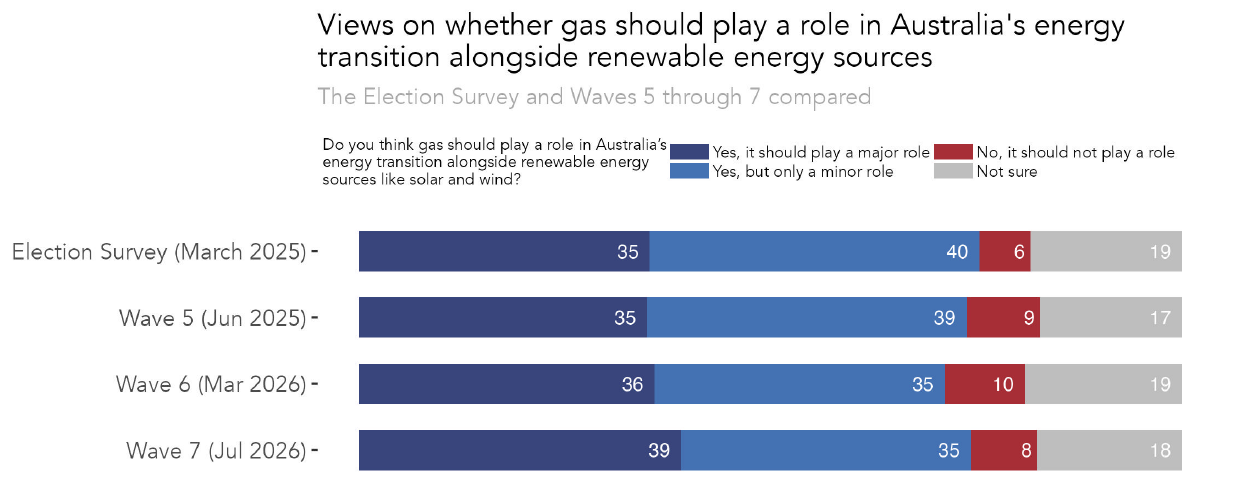
The latest wave also found that 71 per cent of voters believe gas should play a role in Australia’s energy transition alongside renewable energy sources such as solar and wind. This included 36 per cent who said gas should play a major role.

The research suggests that, while views on gas are not uniform across all voter groups, more opinion is currently settling in support than opposition.

Download the research EnergyShift reports

The full EnergyShift research reports are available for download below. Each report includes the detailed findings, question wording, data tables and demographic breakdowns for that wave of the research.

About the study

Methodology

The EnergyShift research survey sample included around 2,000 Australian citizens aged 18 and older who are enrolled to vote.

Respondents were recruited through an online panel, with quotas for age, gender, location, education and vote at the federal election to ensure the sample was representative of the Australian electorate. Rim weighting was applied for age, gender, education and location. The effective sample size has a margin of error of ±2.3 per cent for a 50 per cent result at the 95 per cent confidence level.

Results for subgroups, including age, location, income, education and vote intention, involve larger margins of error and should be interpreted with appropriate caution.

About RedBridge
RedBridge Group is an Australian research, strategy and analytics firm that specialises in research-led insight into social, political and communication challenges. Its work includes public opinion research, political analysis, social research and communications strategy. RedBridge describes its expertise as helping organisations and decision-makers understand complex social, commercial and political landscapes through researched insight.

The EnergyShift research is conducted independently by RedBridge. While the research has been prepared for APGA, APGA does not determine the survey responses, analysis or findings. The purpose of publishing the reports is to make the research accessible and to provide a transparent record of how public attitudes are shifting over time.

Important note to include prominently:
The findings, analysis and conclusions are those of RedBridge. APGA provides access to the research but does not direct or alter the independent research findings.

Questions and follow-up

For questions about the EnergyShift research, member and industry briefings, methodology or findings, please contact:

Matt Williams, Head of Advocacy at APGA, mwilliams@apga.org.au or 0401 126 749

Subscribe for Updates

Subscribe to our mailing list and be the first to access exclusive industry updates, event announcements, and special offers tailored for professionals in the pipeline and energy sector.