

Submission: Gas Networks in Transition
Summary of recommendations
Recommendation One: Reject the rule change proposals
APGA recommends the AEMC reject the consolidated rule change proposals relating to gas networks in transition.
- Such a decision would restore confidence in the stability and integrity of Australia’s existing regulatory framework, reaffirming that the National Gas Rules already provide the necessary tools to manage changes in network utilisation effectively.
- The NGR’s established mechanisms, including prudency and efficiency tests, depreciation flexibility and capital redundancy provisions, enable proportionate responses to genuine market changes without introducing sovereign risk.
- Reaffirming commitment to the current rules will send a clear signal to investors, industry and consumers that Australia remains a predictable, low-risk jurisdiction for energy infrastructure investment — a prerequisite for achieving affordable, reliable and secure energy through the transition.
Introduction
The Australian Pipelines and Gas Association (APGA) represents the owners, operators, designers, constructors and service providers of Australia’s pipeline infrastructure. Our members deliver more than 1,500 PJs of natural gas each year for domestic use and over 4,500 PJs for export markets, underpinned by the highest standards of safety, reliability and operational performance. For decades, this infrastructure has been a cornerstone of Australia’s economic strength, providing secure, low-cost energy that has supported growth, sustained long-term trade, and enabled our domestic industry to compete globally.
APGA welcomes the opportunity to respond to the Australian Energy Market Commission’s (AEMC) consultation on Gas Networks in Transition. Our response is structured around three core issues that cut across the consolidated rule change proposals. In summary, we have serious concerns that the proposed changes are:
- Not in the interests of consumers,
- Would introduce unacceptable sovereign risk by undermining Australia’s stable regulatory regime,
- Threaten the fundamental regulatory compact underpinning infrastructure investment.
Moreover, the proposals respond to concerns that can already be addressed under the existing National Gas Rules (NGR), which provide regulators with tools and flexibility to manage the gas network transition effectively.
APGA urges the Commission to strongly consider the negative consequences outlined. The existing regulatory framework, if applied prudently, can address the challenges of declining gas demand without the need for drastic rule amendments that risk doing more harm than good.
Policy context and underpinning assumptions
The central justification for the proposed rule changes is to protect consumers from the costs associated with “declining gas networks.” While supporting consumers, especially vulnerable ones, must remain a central focus of the regulatory framework, APGA rejects broad-brush assumption gas networks are in terminal decline or require wholesale regulatory re-engineering.
The reality across Australia is far more nuanced:
- Gas networks continue to grow in the majority of jurisdictions, particularly in Western Australia, South Australia and New South Wales. Expansions to new developments and industrial precincts continue, and demand from industry and gas-fired generation to support renewables is expected to grow in many areas over the coming decades[1].
- While overall gas throughput in some networks has declined, this is not simply the result of residential electrification, but a complex combination of factors — including rising input costs, increases in gas appliance efficiency, deindustrialisation, and macroeconomic pressures on commercial users. AEMO itself acknowledges that recent declines in household gas use cannot be attributed to any single factor, noting that changes reflect a mix of electrification, cost-of-living pressures, and reduced commercial activity that are yet to be quantified.
- “AEMO believes this is due to a combination of the electrification of gas loads, cost of living pressures and reduced commercial activity, however at this stage AEMO cannot quantify each of these components.[2]”
- The rule change proposals adopt a linear “gas in decline” narrative that attributes falling demand predominantly to electrification, an assumption AEMO expressly declines to make. By oversimplifying the causes of falling throughput, the proposals risk mistaking structural economic strain for policy progress, and misdiagnosing the drivers of demand. In doing so, they prescribe blunt regulatory interventions that may further undermine industrial viability and network utilisation, compounding economic pressures, damaging sovereign capability, and raising long-term costs for all consumers.
- The assumption that sections of gas networks can simply be shut down or physically decommissioned is unrealistic. Modern networks are designed for resilience, serving variable demand across regions and seasons. What is more likely over time is economic, not physical, redundancy. Some assets may carry lower utilisation but still deliver essential energy services. The real challenge is the risk of economic asset stranding, where prices fall below building block levels and parts of the regulated asset base are left unrecovered. The appropriate response is to adjust depreciation schedules, not dismantle functioning infrastructure. If investors believe the regulator will undermine the regulatory compact and deny recovery of efficient costs, they will withhold investment when it is most needed. Maintaining confidence through predictable depreciation arrangements protects consumers by ensuring continued investment and reliability.
- No federal or state policy framework currently exists to manage full-scale gas network decommissioning. Even in the ACT, the only jurisdiction to announce a long-term phase-out, the practical framework for retiring or repurposing network assets has not yet been developed[3]. Claims of “network decline” are therefore premature and risk misrepresenting the true policy landscape.
- Jurisdictions are actively rejecting sweeping electrification decrees. Most notably, the Victorian Government, following the release of its Building Electrification Regulatory Impact Statement (RIS) in 2025, has explicitly ruled out a blanket gas appliance ban. South Australia, Queensland, Western Australia and New South Wales have taken even stronger positions, underscoring the continued role of gas in the energy mix.
Statements by Australian political leaders:
Commonwealth Government
- “The government does not support a national ban on gas connections to new homes.” – Federal Energy Minister Chris Bowen, November 2023.
New South Wales
- “A statewide gas ban is not something the NSW government is looking at.” – NSW Planning and Public Spaces Minister Paul Scully, June 2025.
- “I think the decision (to “ban gas”) is an overstep by the City of Sydney.” – NSW Premier Chris Minns, June 2025.
South Australia
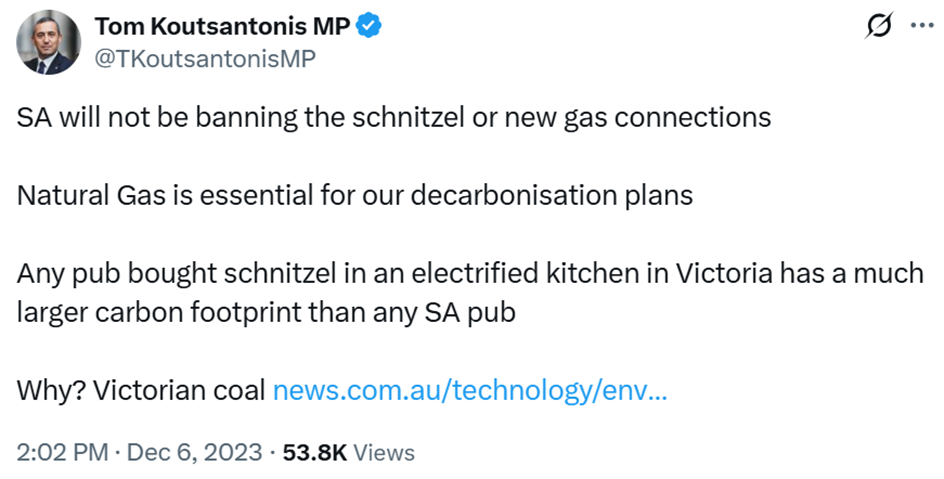
Western Australia
- “We won’t be stopping homes from connecting to gas. Gas will continue to be an important part of our lives, particularly as we transition to a renewable energy future.” – WA Premier Roger Cook, August 2023
The premise of inevitable gas network collapse is inaccurate. It is inconsistent with market dynamics, political direction, and energy planning. Proposals based on this flawed assumption risk distorting incentives, misdirecting investment, and undermining consumer outcomes. Where reform is needed, it should be targeted, proportionate, and grounded in demonstrable consumer and system need, not driven by untested and ideological assumptions.
Risk to consumer outcomes
The proposed rule changes would create new risks for consumers, raising long-term energy costs, discouraging essential investment, and threatens the reliability of the services households and businesses depend on. While intended to shield consumers from the cost of under-utilised assets, the reforms would in practice introduce greater uncertainty into the regulatory framework, increase financing costs, and reduce the incentive to maintain and reinvest in vital gas infrastructure. A stable and predictable regulatory system remains the most effective way to ensure affordability, reliability, and efficiency throughout the energy transition.
Misdiagnosing the source of consumer risk
The proposed rule changes misidentify where risk to consumers truly lies.
The danger is not that gas networks will continue to operate, but that confidence in stable cost recovery will erode, increasing the cost of financing and undermining the investment signals that maintain affordable, reliable energy.
The consultation papers also conflate physical stranding, when an asset can no longer operate safely or is technically obsolete, with economic stranding, which occurs when policy or market interventions prevent recovery of efficient costs even while the asset remains in use. This distinction is critical. Physical asset stranding is a function of physical use, whereas economic asset stranding is a function of achievable price. Managing genuine physical redundancy is already possible under existing rules, but engineering artificial economic loss through premature write-downs would only elevate consumer costs in the long term.
Australia’s National Gas Rules already provide clear, proven mechanisms to manage changes in asset utilisation efficiently. The regulator can vary depreciation schedules, apply prudency and efficiency tests, and respond to genuine market changes through review and pass-through provisions. These powers ensure proportionate, evidence-based responses to actual utilisation changes without undermining investor certainty or service reliability.
Specifically:
- Rule 89(1) allows depreciation over an asset’s economic life and gives the AER discretion to adjust lives when market conditions change—ensuring recovery of efficiently incurred costs while maintaining discipline.
- Revenue and Pricing Principles (RPP 2–7) require that service providers have confidence in cost recovery, that depreciation reflect efficient use and investment incentives, and that the regulator weigh the economic costs of both under- and over-utilisation.
- Rule 85 (Capital redundancy) permits removal of genuinely unused assets from the capital base but also obliges the regulator to consider the uncertainty such action would create for both service providers and consumers.
Taken together, these provisions confirm the NGR already gives the AER flexibility to manage economic asset stranding through adjustments to depreciation, cash-flow timing, prudency reviews and access-arrangement variations. No new rules are required: the mechanisms to respond to genuine, evidence-based utilisation changes already exist within the framework.
The proposed framework would require the regulator to forecast future utilisation, revalue assets and effectively write down the regulatory asset base in advance. This would transform hypothetical risk into immediate loss, undermining the predictable, rules-based environment that underpins affordable prices. It would also encourage premature disinvestment, leading to under-maintained assets, higher unplanned outages and poorer service reliability, particularly in regions where gas remains critical for heating and industrial supply.
The self-fulfilling decline problem
The greatest risk to consumers is that a poorly designed regulatory intervention becomes self-fulfilling. Forecasting economic stranding before it occurs and imposing losses in advance would be unprecedented — no jurisdiction in the world does this. Even in the few countries where firms bear asset stranding risk, that exposure only applies after an asset has demonstrably stranded, not before.
If investors believe sunk costs are exposed to discretionary or pre-emptive write-downs, they will rationally restrict spending to the minimum necessary to meet safety obligations. Networks would remain safe and compliant, but their ability to deliver long-term reliability, efficiency and innovation would diminish. In practice, systems would become technically secure but brittle — unable to adapt, renew or integrate renewable gas solutions efficiently. Once the regulatory compact is weakened, the perceived decline in network value becomes a reality driven not by demand, but by regulatory design itself.
This is precisely the dynamic highlighted in international experience (outlined below) and economic literature: when governments signal that the rules of cost recovery can change midstream, investment collapses, non-safety maintenance is deferred, and service quality deteriorates—outcomes that ultimately harm consumers. Such an environment would leave consumers with less reliable, less adaptable, and ultimately more expensive energy services.
The impacts would be particularly acute for regional and industrial consumers that depend on gas for process heat, food manufacturing, and chemical production. These users cannot easily electrify or switch fuels without significant capital expenditure. A regulatory-induced withdrawal of investment would expose them to reliability shortfalls and higher input costs, weakening domestic industry competitiveness and threatening employment in gas-dependent regions.
The proposed regulatory reforms also are in direct conflict with the Federal Government’s Future Made in Australia strategy (FMIA). The strategy explicitly aims to rebuild Australia’s manufacturing base, secure industrial supply chains, and strengthen sovereign capability through targeted incentives such as production tax credits and investment in critical minerals processing and low-carbon manufacturing. Each of these priorities will depend on reliable, affordable, and scalable gas supply to power high-temperature processes, provide feedstock for ammonia production, and support industrial precincts in regional Australia.
Undermining the regulatory framework for gas infrastructure would therefore not only weaken investor confidence but also directly constrain the very sectors the FMIA seeks to grow. By eroding the stability needed for long-term investment, this regulatory design risks breaking the networks that Australia’s industrial and manufacturing future depends on.
How consumers would be affected
The link between regulatory instability and consumer harm is well established:
- Higher network charges: Credit-rating agencies point to regulatory stability as a critical factor in the credit quality of regulated utilities. Moody’s notes that the regulatory framework is “a key determinant of the credit quality of a utility.”[4] A downgrade in credit rating increases borrowing costs, which are then passed into consumer tariffs. Modelling across regulated infrastructure suggests that even a single-notch downgrade can raise financing spreads and ultimately lead to higher network charges.
- Reduced reliability: When recovery certainty falls, networks defer non-mandatory upgrades and shift to short-term maintenance. International evidence[5] shows this behaviour leads to slower restoration times, ultimately affecting consumers first.
- Equity impacts: Households least able to electrify would bear a disproportionate share of fixed network costs as others exit. Regulatory interventions that accelerate this dynamic would amplify, not reduce, energy inequity.
- Slower decarbonisation: Prematurely undermining gas networks would delay the integration of renewable gases such as biomethane and hydrogen, which rely on the same infrastructure for early deployment.
Case Study: Australian Energy Market Commission 2012 decision on RAB optimisation[6]
What happened
In 2012, the AEMC rejected a rule change proposed by the Major Energy Users Association that would have required regulators to “optimise” the regulatory asset base (RAB) at each reset—effectively writing down under-utilised assets. The Commission found the existing rules already allowed the regulator to manage utilisation through depreciation flexibility and prudency tests. It concluded that mandated revaluations would increase regulatory risk, deter investment and add complexity with no clear consumer benefit.[7]
Why it matters now
The current ECA and JEC proposals go well beyond the 2012 precedent. Then, the intent was to address assets that were actually underutilised by writing them out of the RAB after the fact. The current proposals would allow the regulator to write out assets that might be underutilised in the future — effectively forecasting stranding before it occurs.
Forecasting stranding and imposing losses in advance would mark a radical break from established regulatory principles and create precisely the investor uncertainty that drives up consumer costs.
The 2012 process demonstrated that expanding regulatory discretion to revalue sunk assets increases perceived risk, lifts financing costs, and ultimately raises prices for consumers. By contrast, the AEMC’s decision to preserve the existing framework delivered a decade of stable investment and declining real network charges. That same stability is now essential to ensure efficient investment, protect consumers, and enable an orderly energy transition.
Lessons from international experience
There is no international precedent in which retrospective interference with cost recovery has produced positive outcomes for consumers. Across markets and decades, attempts by governments or regulators to alter the terms of investment once assets are sunk have led to the same results: higher long-term prices, weaker service quality and diminished investor confidence. These outcomes are not coincidental but structural.
When regulators exercise discretion to rewrite cost recovery rules in response to political or short-term price pressure, capital markets respond rationally, demanding higher risk premiums or withdrawing investment altogether. The resulting underinvestment, reduced maintenance, and system fragility ultimately translate into higher costs and poorer reliability for consumers.
Case Study: Argentina – Regulatory opportunism and consumer harm
In the late 1990s and early 2000s, Argentina’s government froze utility tariffs and retrospectively altered cost recovery arrangements for electricity, gas and water companies. These actions were intended to shield consumers from short-term price increases following currency devaluation, but they also broke the stable, contract-based frameworks that underpinned private investment in essential services.
What happened
Regulatory uncertainty grew rapidly as the government overrode concession contracts, delayed cost-recovery adjustments, and introduced ad hoc price controls. With no reliable mechanism to recover efficient costs, utilities cut maintenance, deferred network renewal, and reduced capital investment. Reliability and safety declined sharply, the power sector experienced widespread blackouts, and water utilities reported contamination and service rationing. By 2006, most foreign investors had exited, forcing the government to re-nationalise major utilities at significant cost.
Consumer outcomes
While short-term bills were suppressed, consumers ultimately paid more through degraded service quality, energy insecurity, and the public debt required to fund re-nationalised networks. The World Bank[8] and Inter-American Development Bank[9] both identified these interventions as examples of “regulatory opportunism” that increased long-term consumer costs and damaged investor confidence for decades.
In short, consumer protection is best achieved through predictable, evidence-based regulation, not by rewriting the rules of cost recovery midstream. The existing framework already empowers the AER to respond proportionately to real utilisation changes. Expanding its discretion to anticipate future decline would expose consumers to higher prices, weaker reliability and slower decarbonisation — precisely the outcomes the reforms claim to avoid.
These risks extend beyond consumers to Australia’s broader investment reputation. The strength of the gas regulatory framework has long rested on its consistency, transparency and respect for the reasonable opportunity to recover efficient costs — principles that underpin not only affordability but also Australia’s sovereign credit standing. Undermining these foundations would introduce unacceptable sovereign risk by signalling to investors that the rules governing long-term infrastructure can change midstream.
Introduction of unacceptable sovereign risk
Sovereign risk in energy infrastructure arises when governments or regulators retrospectively alter the rules governing investment recovery, changing the terms on which long-lived assets are financed. In capital-intensive utilities like gas networks, where assets may operate for decades, stability and predictability of cost-recovery arrangements are essential to maintaining affordable energy for consumers.
Recent events demonstrate that Australia’s gas market is already experiencing strains. For example, in the wake of soaring global gas prices in 2022, the federal government introduced new policy interventions for the east-coast gas market, including a A$12/GJ price cap and an extended domestic gas security mechanism, which S&P Global said could “place Australia’s reputation as a reliable and secure supplier of energy at risk in the international market.”[10]
Similarly, commentary from the Australian Strategic Policy Institute described the east-coast gas supply situation as “a sovereignty issue, not a market quirk,” arguing that infrastructure and regulatory planning failures in the gas sector threaten national resilience.[11]
These signals matter for investor confidence. As Moody’s Investors Service notes in its 2022 methodology for regulated electric and gas networks, “the predictability and stability of the regulatory regime” and “the ability and timeliness of cost and investment recovery” form a central component of the credit rating framework, together accounting for roughly one-third of a utility’s rating[12]. A loss of confidence in these principles would directly translate into higher financing costs, reduced capital inflows, and, ultimately, higher tariffs for consumers.
Australia has historically been seen as one of the most stable jurisdictions for energy infrastructure investment. However, the current suite of rule-change proposals would signal a shift: from a predictable, principle-based regime to one in which regulators are empowered to reassess, and potentially revalue, assets based on speculative future utilisation. That uncertainty constitutes sovereign risk. It undermines the core expectation that efficient investment, once prudently incurred under an approved framework, will be recoverable over the economic life of the asset.
Contagion across infrastructure sectors
The implications of sovereign risk extend far beyond the gas sector. Once regulators demonstrate a willingness to reopen or expropriate sunk capital in one network industry, the credibility of all regulated frameworks comes into question. Since infrastructure assets share many regulatory and investment-recovery features, investor concern about one network industry’s regulatory regime can increase perceived jurisdictional risk more broadly. This means a regulatory intervention in the gas sector can feed through to higher cost of capital for electricity, water or transport networks because capital is priced according to systemic confidence in jurisdictional regulation
According to Infrastructure Partnerships Australia’s 2024 Infrastructure Investment Monitor, a majority of international investors identify regulatory and policy uncertainty as a leading deterrent to Australian infrastructure investment[13]. Similarly, Macquarie Group observes that regulatory unpredictability is now the “single largest non-market risk premium” faced by infrastructure investors globally[14].
Because the current proposals would require regulators to expropriate assets based on uncertain forecasts, they create strong incentives for lobbyists and short-term interests to push for the harshest possible demand assumptions. Those with no financial exposure would face no downside if their forecasts prove wrong, but networks cannot recover assets once written down. Even if regulators act in good faith, this framework builds in structural uncertainty that investors will interpret as a sign of sovereign risk.
If regulators in one sector are seen to retrospectively alter cost-recovery expectations, investors will rationally apply a higher risk premium across all regulated utilities. This contagion effect would raise the cost of capital for electricity transmission projects, renewable-energy hubs, and water and transport networks alike. It would directly undermine the objectives of the Future Made in Australia strategy, which depends on Australia being viewed as a low-risk, rules-based destination for industrial and infrastructure investment.
In short, regulatory chilling in gas would not remain confined to gas. They would weaken Australia’s reputation as a stable investment jurisdiction, elevate financing costs across the entire infrastructure portfolio, and compromise the affordability of the energy transition itself.
Case Study: Ofgem’s retrospective revaluation and investor backlash (UK 2020–2023)
In 2020, the UK energy regulator Ofgem introduced the RIIO-2 price control for electricity and gas networks, significantly lowering allowed returns and altering depreciation and cost-of-capital parameters mid-framework. Investors interpreted the decision as a retrospective shift in the regulatory contract, undermining expectations of stable recovery for long-lived infrastructure.
The response was swift. Multiple global investors, including pension funds and sovereign wealth investors with stakes in UK utilities, publicly warned that the UK had become a “less predictable regulatory environment.” Fitch Ratings and Moody’s subsequently cited regulatory intervention risk as a negative credit-rating driver for UK energy networks. Several proposed sales and capital programs were delayed or downsized, including National Grid’s UK gas distribution business, which was sold in 2021 at a lower multiple than comparable regulated assets in continental Europe.
By 2023, the Global Infrastructure Investor Association (GIIA) reported that “the perceived unattractiveness of the UK’s regulatory regimes” had become one of the leading deterrents to infrastructure investment in the country, a clear sign of sovereign-style risk contagion within a mature, rules-based market.
Lesson for Australia
The Ofgem experience demonstrates that even well-intentioned regulatory adjustments, when perceived as retrospective or politically motivated, can erode sovereign credibility, increase risk premiums, and slow capital deployment across network sectors. Introducing similar discretion for the AER to vary depreciation or pre-emptively write down the RAB would expose Australia to the same pattern of capital flight and higher consumer costs.
The lesson from both international and domestic experience is clear: sovereign risk does not emerge in isolation. It begins when the implicit trust between investors, regulators and governments, the regulatory compact is weakened.
Australia’s energy markets have long benefited from a compact built on transparency, predictability and mutual accountability. Once that understanding is rewritten, confidence in the entire regulatory framework begins to unravel. The next section examines how the current rule-change proposals threaten this compact, undermining the very principles that have underpinned decades of efficient investment, consumer protection and energy reliability.
Threat to the regulatory compact
Australia’s energy regulatory framework is built on a longstanding regulatory compact — the explicit understanding between investors, regulators and consumers that efficient investment, once prudently incurred under an approved framework, will be recoverable over the economic life of the asset. This compact is the foundation of hundreds of thousands of kilometres of transmission and network infrastructure, billions of dollars in investment and decades of reliable service delivery.
The compact in Australian law
The National Gas Law’s Revenue and Pricing Principles codify this understanding.
- RPP (2) provides that a service provider “should be provided with a reasonable opportunity to recover at least the efficient costs” of providing reference services and complying with regulatory obligations.
- RPP (6) and RPP (7) require that the regulator consider the economic costs of both under- and over-utilisation, and maintain incentives for efficient investment.
Together, these provisions articulate a promise of regulatory stability that efficient, prudent capital deployed to deliver essential services will not be retrospectively devalued through regulatory discretion. This compact is not theoretical: it is the foundation upon which every major distribution gas network asset in Australia has been financed.
Why the compact matters
The regulatory compact underpins Australia’s reputation as an investment jurisdiction. For capital-intensive utilities with asset lives exceeding 30 years, predictable cost-recovery arrangements enable low-cost financing and efficient long-term planning.
If regulators are perceived to hold discretion to reopen or revalue settled cost recovery arrangements, for example by writing down the Regulatory Asset Base based on anticipated decline, the regulatory compact is weakened. Moody’s rating methodology for regulated electric and gas networks makes clear that predictability, transparency and cost recovery within the regulatory framework form a core component of a utility’s credit rating. Any departure from this principle would trigger higher financing costs, reduced investor participation and ultimately a greater cost burden on consumers.
How the proposals undermine the regulatory compact
The consolidated rule-change proposals would represent the most significant departure from Australia’s established regulatory principles since the inception of the National Gas Rules. While presented as a response to “declining gas demand,” they would in practice dismantle the foundational elements of the regulatory compact by introducing subjectivity, uncertainty, and discretionary intervention into what has long been a stable, rules-based framework.
Each of the proposed mechanisms, particularly the ability to forecast “anticipated redundancy,” vary depreciation to pre-empt decline, and remove assets from the regulatory base, would shift the compact from one grounded in prudency and efficiency to one dominated by speculative risk allocation. The consequences are clear: diminished investor confidence, distorted incentives, and higher costs for consumers.
- Shifting from evidence-based regulation to speculative forecasting
Under current arrangements, regulatory determinations are grounded in evidence – historical utilisation data, prudency tests, and efficiency assessments under Rules 79, 85, and 89. The proposals would overturn this approach by empowering the AER to forecast future utilisation and write down the Regulatory Asset Base based on predictions of “anticipated redundancy.”
This fundamentally transforms the regulator’s role from impartial arbiter to forecaster of market and policy outcomes. This would require the regulator to substitute prudency-based assessment for speculative modelling. In effect, investors would no longer be able to rely on objective, evidence-based cost recovery but would instead face regulatory decisions tied to uncertain long-term policy trajectories.
By replacing measurable criteria with prediction, the proposals sever the link between efficient investment and guaranteed recovery, the very foundation of the compact.
- Retrospective revaluation and erosion of sunk-cost protection
The proposals are explicit in their intent: to enable the regulator to reassess historical investment decisions in light of evolving policy objectives. They argue investors “should have foreseen” the trajectory of decarbonisation and therefore must bear the cost of network redundancy.
This rationale inverts the purpose of the regulatory compact. Efficient investment is made under the rules and policy settings prevailing at the time of approval, not in hindsight. Allowing the regulator to revalue or remove assets from the approved regulated asset base based on ex-post changes in policy direction introduces a form of retrospective expropriation.
The AEMC has previously rejected similar attempts. As noted in the earlier case study, in the AEMC’s 2012 decision on RAB optimisation[15], the Commission concluded that forced revaluations “would increase regulatory risk, deter investment and add complexity with no clear benefit to consumers.” The current proposals would reintroduce precisely those risks, signalling to investors that Australia’s regulatory environment is no longer anchored in the principle of non-retrospectivity — a hallmark of sovereign reliability.
- Incentivising short-termism and disinvestment
By exposing efficient capital expenditure to discretionary write-downs, the proposals would make long-term investment in regulated networks economically irrational. Faced with heightened risk, service providers would logically pivot from capital expenditure, which delivers durable network improvements, to operating expenditure, which carries no long-term recovery exposure but provides only short-term fixes.
Where capex solutions are subject to appropriation, networks will seek opex solutions, producing networks that are safe but brittle. In practice, this means deferring maintenance, postponing asset renewal, and abandoning innovation projects such as renewable gas integration. Such an outcome would run directly counter to the Federal Government’s own policy direction, particularly as it develops its Renewable Gas Options Paper for the Energy and Climate Ministerial Council (ECMC)[16]. That process explicitly seeks to accelerate investment in renewable gas production, transport and injection using existing network infrastructure — the very kind of forward-looking innovation that these rule-change proposals would discourage.
The resulting system would comply with minimum safety obligations but would be less reliable, less efficient, and ultimately more expensive for consumers. This pattern of disinvestment is not theoretical but observable in jurisdictions where cost-recovery rules have been weakened, including the UK under Ofgem’s RIIO-2 regime and Latin American markets post-liberalisation.
- Creating cross-sector contagion and moral hazard
Finally, once regulators demonstrate a willingness to expropriate sunk capital in one sector, the precedent applies across all regulated utilities. Infrastructure investors, including superannuation funds and sovereign wealth funds, do not distinguish between gas, electricity, or transport risk; they assess jurisdictional predictability.
This moral hazard is twofold:
- It undermines the incentive for regulators to apply discipline consistently across sectors.
- It forces investors to demand a higher return for all future infrastructure projects to hedge against potential expropriation.
The resulting premium inflates the cost of capital for electricity transmission, renewable generation, water utilities, and even transport infrastructure — directly undermining the Commonwealth’s Future Made in Australia strategy, which depends on large-scale, low-cost capital deployment.
Summary
Taken together, the proposed rule changes would unravel the very principles that have sustained Australia’s regulatory credibility for over three decades. They would replace predictability with discretion, evidence with speculation, and long-term efficiency with short-term reaction.
In doing so, they would not only erode the regulatory compact but also jeopardise Australia’s standing as a trusted destination for infrastructure investment, exposing consumers, industry and government alike to higher costs and diminished resilience.
Conclusion
The consolidated rule change proposals represent a fundamental departure from Australia’s proven regulatory framework. They would replace stability with discretion, prudence with speculation, and long-term efficiency with short term intervention.
As consistently noted throughout this submission, the National Gas Rules already provide the Australian Energy Regulator with all necessary powers to manage genuine utilisation changes, including prudency reviews, depreciation flexibility and capital redundancy provisions, without introducing sovereign risk or undermining investor confidence.
Reopening settled cost recovery arrangements would not protect consumers. It would expose them to higher prices, weaker reliability and delayed decarbonisation. It would also contradict the Federal Government’s FMIA strategy by deterring investment in renewable gas, manufacturing and energy infrastructure that depend on a predictable, low risk regulatory environment.
The lesson from international and domestic experience is clear. Once confidence in the regulatory compact is weakened, investor trust, system performance and consumer outcomes deteriorate together. APGA therefore urges the AEMC to reject the proposed rule changes, reaffirm the integrity of the existing framework and send a clear signal that Australia remains a stable, rules-based jurisdiction committed to affordable, reliable and secure energy for all consumers.
APGA and its members appreciate the opportunity to respond to this consultation and looks forward to working with the Commission and governments to ensure the existing framework continues to deliver efficient, consumer-focused outcomes through the energy transition.
Consultation Questions
|
Question |
Response |
|
1. What are the issues impacting consumers and gas distributors under the energy transition? |
Consumers are navigating a broad cost-of-living squeeze across all utilities. Electricity and gas bills reflect higher network and generation costs, new investment to support decarbonisation, and a growing layer of policy and environmental costs recovered through bills. The question is how to manage these system costs fairly and efficiently while maintaining reliability and choice. The majority of Australian households and businesses still value gas for affordability, reliability and cooking or process needs. Policy settings that remove connection options or prejudge decommissioning risk reducing competition between energy choices. Where customers who can afford to electrify exit first, those with fewer options can face higher per unit charges as fixed costs are recovered from a smaller base. That creates equity concerns for low income and regional households. The shift to electrification also places upward pressure on electricity prices. Large new transmission and distribution investment is required to meet higher peak demand and integrate variable renewables. If gas demand for heating and firming is forced rapidly into electricity, these pressures rise further. Using existing gas infrastructure helps relieve the electricity system and supports an orderly transition. For distributors, the transition brings demand uncertainty, which complicates long term planning and recovery of efficient costs. Networks must continue to meet household, commercial and industrial demand and support gas fired firming while readying assets for renewable gases such as biomethane and hydrogen. These readiness costs are not fully recognised in current settings. Regulatory predictability is essential. Proposals that enable retrospective write downs or remove recovery of efficient capital would increase financing costs, deter investment and risk poorer outcomes for consumers. International practice shows regulators adapting within existing frameworks, not rewriting compact principles. Australia must avoid creating sovereign risk by departing from that norm. In short, the task is to keep bills as low as practical, protect vulnerable customers, preserve genuine energy choice and maintain confidence to invest in safe and efficient networks that will continue to support reliability and decarbonisation for decades. |
|
Do stakeholders agree there is value in considering the additional NGR issues identified alongside the issues raised in the rule change requests? |
We see limited value in expanding the review beyond the original scope of the rule change requests. The current National Gas Rules already provide the regulator with sufficient flexibility to manage demand uncertainty, adjust depreciation schedules, and ensure efficient risk allocation between service providers and consumers. Where refinements are genuinely warranted, such as longer-term demand or expenditure forecasting, these can be developed within the existing framework following cost–benefit analysis rather than through wholesale rule changes. Broadening the review risks creating a cycle of ongoing regulatory intervention, where each reform triggers further adjustment and uncertainty. This would undermine the integrity of the regulatory compact, increase financing costs, and ultimately raise prices for consumers. Stability and predictability remain prerequisites for long-term investment that delivers reliability, affordability, and decarbonisation outcomes. We recognise the AEMC’s view that “the regulator and service providers may need more flexibility, guidance and tools to promote the long-term interests of consumers.” However, genuine flexibility will come from clearer and more consistent policy direction — not from additional rule amendments. More fundamentally, we question whether a potential decline in gas demand should be treated as a regulatory concern at all. Australia’s overall gas use is not in structural decline, and even if residential demand moderates, the system-wide need for gas in industry, firming generation, and emerging renewable gas markets remains significant. Indeed, any large-scale shift of gas demand onto electricity networks would require major new electricity infrastructure investment, driving up costs across the economy. In APGA’s view, the NGR remains robust and adaptable. The focus should be on improving how it is applied, not prescribing limitations to its application or expanding its scope. A stable, predictable framework is essential for maintaining investor confidence and delivering outcomes that truly serve the long-term interests of consumers. |
|
Are there any other additional issues that should be considered within the NGR framework? Why? |
No. The current NGR already provides the flexibility needed to manage demand uncertainty, including the revision of economic asset lives where appropriate. The challenge lies in consistent regulatory application, not in the framework itself. The AER has sufficient discretion to maintain price stability and ensure efficient cost recovery. Expanding the rules would only introduce new uncertainty, raise financing costs and distract from the need for clearer policy direction. |
|
Are there changes outside the NGR regulatory framework required to address the issues raised in the rule change requests? |
What is needed is national policy clarity, not further regulatory experimentation. The rule change proposals start from the wrong problem definition. They attempt to use economic regulation to solve what is fundamentally a policy and market design challenge. Governments must first articulate how they intend to manage the energy transition, including the future role of gas, connection policy and emissions frameworks, before regulatory settings can sensibly evolve. In particular, where governments are pursuing electrification objectives, they must also map out how these policies will be implemented in each jurisdiction without imposing one size fits all frameworks that penalise regions or industries which still depend on gas. Regulation should not be used to export the policy preferences of one jurisdiction to others through the rule making process. Gas remains an accepted part of Australia’s transition pathway, supported by the Federal Government through the Future Gas Strategy and the ECMC’s work on renewable gas. These frameworks recognise the enduring value of gas in firming, households, industry and renewable gas development, all of which require stable regulatory conditions to attract investment. The ACT’s approach is not a model for national reform. Its narrow implementation plan reflects local politics rather than economic efficiency. Other jurisdictions have rejected similar measures because of the second order effects on energy security, consumer choice and industrial competitiveness. In practice, businesses are already managing transition risks through prudent revision of economic asset lives and ongoing efficiency improvements within the existing framework. The challenge lies not in the absence of regulatory tools but in maintaining consistent policy direction that supports their effective use. |
|
2. What changes, if any, should be made to the NGR capital expenditure criteria? |
No changes are required. The current capital expenditure criteria already ensure investment is prudent, efficient and in the long-term interests of consumers. The framework gives the regulator clear oversight while respecting the technical expertise of network operators, who are best placed to determine what is necessary to maintain asset integrity, reliability and safety. Altering the criteria would blur this balance and risk shifting costs from capital to operating expenditure, which would ultimately be less efficient and more expensive for consumers. The existing approach has proven effective and should be preserved. The proposed amendments do not advance the National Gas Objective (NGO) and would undermine efficiency, accountability and investor confidence. Specifically: · Look-back test: Requiring the regulator to assess whether past investments were prudent before approving replacement capex would create retrospective uncertainty and discourage long-term investment. · Safety exclusions: Removing safety-related projects from conforming capex would conflict with evolving Australian Safety Standards and create a perverse incentive to defer NPV-negative safety upgrades. · Renewable exclusions: Preventing renewable-related capex would conflict with the NGL, which allows pipeline services to include renewable gas transport, and would constrain the regulator’s ability to set reference services. · Electricity-style criteria: Linking capex to customer reliability values or demand management misapplies electricity principles to gas networks, which operate differently and prioritise continuous system safety and integrity. Together, these proposals would distort capex/opex trade-offs, increase regulatory subjectivity and undermine investor confidence. The current framework provides the right balance between accountability and discretion. It safeguards consumers while maintaining the stability needed for efficient, safe and affordable gas infrastructure. |
|
Should criteria better account for uncertainty in future gas demand? Would ECA’s proposed amendments achieve this? |
No. The current framework already accounts for uncertainty in future gas demand through established forecasting, prudency and efficiency tests. Service providers are inherently incentivised to minimise economic stranding risk because it is in their commercial and reputational interests to do so. Networks face the real risk they cannot recover their investment if customers one day leave the network, which makes them naturally conservative in their investment decisions, particularly for long-lived assets. It is worth noting that the AEMC’s own problem statement assumes the current regulatory framework was designed around perpetual demand growth. That assumption is incorrect. The framework already allows the AER to adjust depreciation schedules, capital programs and expenditure forecasts where demand materially changes. These tools provide ample flexibility to manage uncertainty without rewriting the rules. ECA’s proposed amendments attempt to regulate against a problem that does not exist. The risk of economic stranding is already managed through prudent investment decisions and revision of economic asset lives where needed. Adding new regulatory prescriptions would only duplicate existing safeguards, increase complexity and deter investment at the very time reliable gas infrastructure is most critical to the energy transition. |
|
What are the benefits and costs of ECA’s proposed approach (for consumers, service providers, regulator)? |
ECA’s proposed approach would impose significant costs while providing no clear benefit to consumers. Allowing the regulator to retrospectively reassess efficient capital expenditure or revalue the regulated asset base would undermine confidence in the regulatory compact that underpins all major energy infrastructure investment in Australia. The regulatory compact works because service providers accept extensive obligations to operate safely and efficiently in exchange for a reasonable opportunity to recover at least efficient costs over the life of the asset. ECA’s proposal would weaken that balance by creating uncertainty about cost recovery after investment has already been committed. That uncertainty would raise financing costs across the sector and deter the long-term capital required to maintain and upgrade critical infrastructure, including renewable gas integration – a clear policy priority as outlined by the ECMC and state jurisdictions. Consumers would ultimately face higher prices and reduced reliability as investors respond by demanding higher returns to offset regulatory risk. The regulator, meanwhile, would be forced into repeated reassessments of past decisions, increasing administrative burden without improving efficiency or consumer outcomes. The current framework already provides the regulator with robust powers to test prudency and efficiency through established review mechanisms. Adding new retrospective powers would duplicate those safeguards, create regulatory inconsistency and conflict with established AEMC rulings that rejected ex post asset revaluations. ECA’s proposal therefore represents unnecessary intervention that would destabilise the established regulatory balance, misallocate risk and deliver poorer outcomes for both investors and consumers.
|
|
Are there any alternative, preferable solutions to address the issues identified with current capital expenditure criteria? |
The existing capital expenditure framework remains sound and adaptable. The issues identified by ECA can be addressed through consistent application of current rules and clearer regulatory guidance rather than structural reform. Creating new rules to solve a problem that is already managed within the current framework would only introduce instability. The existing regime already enables the regulator to address demand uncertainty, revise economic asset lives and ensure investment remains prudent and efficient. The challenge is not the absence of regulatory tools, but their consistent and balanced application. Expanding the framework risks signalling that the regulatory compact across all regulated assets is open to renegotiation. This would increase uncertainty and deter investment at a time when stability is essential for maintaining confidence in Australia’s energy and infrastructure markets. |
|
Do you consider changes are required to the rules in relation to advance determinations on capital expenditure (rule 80(2)? Views on ECA’s proposal (remove or require consultation)? |
No. The current rule is adequate. Advance determinations on capital expenditure occur infrequently, and when they do, the AER already has the capability and established processes to assess the expenditure under existing prudency and efficiency tests. There is no evidence that additional prescription would improve outcomes for consumers or service providers. Introducing new requirements for consultation or additional procedural steps would only add delay and cost without delivering any practical benefit. By the time an advance determination had completed a consultation process, the standard regulatory approval cycle would typically have caught up, rendering the mechanism redundant. Decommissioning and end-of-life costs will naturally emerge over time, but they can be managed through the existing framework without new rule changes. The focus should remain on applying the current provisions consistently rather than expanding them unnecessarily. |
|
Do you consider additional types of expenditure may need to be recognised as capital expenditure in the transition (e.g. decommissioning)? |
Decommissioning and end-of-life costs will emerge over time, but they do not require new rules under the current framework. However, we agree these costs should be transparently recognised in benefit–cost analyses for new capital projects. Excluding them would systematically bias project evaluations by understating total lifecycle costs and undervaluing efficient investment. If the ECA’s proposed rule changes were adopted, they would create the very need they claim to solve. Shortening asset lives or constraining cost recovery would simply bring forward decommissioning and remediation activities that would otherwise occur later in the asset cycle. These financial adjustments change the timing of costs, not their underlying value, and could require the creation of mechanisms such as a sinking fund or targeted investment allowance to manage the brought-forward liabilities. In practice, accelerated depreciation reduces decommissioning costs in present value terms, while asset write-downs or constrained recovery would delay them. Both are financial treatments of the same economic obligation. The focus should therefore remain on clear and consistent recognition of these costs within existing prudency and efficiency tests rather than new rule-based definitions of capital expenditure. |
|
3. Are any changes required for operating expenditure? |
No. The current definition of operating expenditure already provides the flexibility needed to support efficient network operation, demand management and the integration of new technologies. It enables the regulator to assess prudency, efficiency and long-term consumer benefit without prescribing how businesses should manage their costs. Removing or narrowing the scope of opex that supports demand growth would introduce inconsistency into the regulatory framework. Under both price cap and hybrid models, distributors bear the demand risk, and operating expenditure is one of the few tools available to manage that risk effectively. Eliminating this flexibility would prevent service providers from responding efficiently to changes in demand, potentially increasing costs and reducing reliability for consumers. The existing framework therefore remains fit for purpose. It provides clear incentives for efficiency, ensures accountability to consumers and supports stable network operation during the transition. No further rule changes are required. |
|
Is the current definition (including expenditure for increasing long-term demand) fit for purpose in the transition? |
Yes. The current definition of operating expenditure is fit for purpose and provides the flexibility needed to manage efficient investment through the transition. It allows networks to balance capital and operating expenditure decisions in the long-term interests of consumers. If the ECA’s proposed rule changes to capital expenditure were adopted, the regulator would inevitably need to relax both capex and opex constraints to maintain this balance. Tightening capital rules without corresponding flexibility in operating expenditure would create distortions in investment decisions and reduce overall efficiency. The current framework already gives the regulator all necessary tools to assess prudency and efficiency while enabling service providers to choose the least-cost solution, whether capex or opex, to meet demand. The more effective approach is to preserve these existing definitions and ensure the AER applies them consistently. Introducing new or parallel reforms would add complexity, increase administrative burden and risk higher costs to consumers. |
|
Do you consider additional types of operating expenditure may need to be recognised in the transition? |
No. The current framework already allows the regulator to recognise legitimate operating expenditure where it is efficient and in the long-term interests of consumers. Maintaining this approach preserves the balance between operating and capital expenditure and avoids unnecessary increases in total system costs. If, however, the regulator were to introduce write-downs of the regulated asset base, there would need to be a compensating provision to preserve Net Present Value neutrality and the regulatory compact. Asset stranding risk is asymmetric and not captured in the standard WACC, so any write-down would require an offset through cash flows. That can be achieved either by adjusting asset lives dynamically or, if necessary, by providing an explicit ex-ante operating allowance that reflects the additional risk borne by service providers. Absent such a policy shift, no new operating expenditure categories are required. The focus should remain on consistent application of the existing rules. |
|
Does the framework appropriately balance incentives between capital-intensive solutions and maintenance/asset management solutions? If not, what changes are needed? |
Yes. The current framework provides an appropriate balance between capital-intensive and maintenance-based solutions by rewarding efficiency regardless of investment type. If the ECA’s proposed rule changes were implemented, that balance would be lost. Restricting capital recovery would push businesses toward higher-cost operating or short-term maintenance solutions that are less efficient and ultimately more expensive for consumers. The existing framework already drives efficient decision-making and should be retained. |
|
4. Does the current framework effectively manage and allocate risk and costs between consumers and network service providers in the context of uncertain demand? |
Yes. The current framework provides an effective and balanced mechanism to manage and allocate risk between consumers and network service providers under conditions of demand uncertainty. Economic regulation of gas networks is founded on the regulatory compact, which provides a reasonable opportunity for cost recovery in exchange for strict service obligations and efficiency incentives. This arrangement ensures that consumers pay no more than efficient costs while networks retain the confidence to invest in maintaining reliability, safety and long-term affordability. The National Gas Rules already give the regulator flexibility to adjust depreciation schedules, capital programs and expenditure forecasts as demand changes. These tools allow economic stranding risk to be managed without rewriting the rules or undermining the compact. The framework’s design means that networks bear the commercial consequences of inefficient or excessive investment, while consumers are protected from unnecessary costs through the AER’s prudency and efficiency tests. Proposals to pre-emptively forecast stranding and impose losses in advance would distort this balance. They would expose investors to discretionary revaluation risk, elevate financing costs, and ultimately increase consumer prices. Internationally, no jurisdiction forecasts economic stranding before it occurs, and such a move would be seen by investors as a radical departure from established regulatory practice. In short, the current framework already manages risk efficiently and fairly. The challenge lies not in the design of the rules, but in their consistent and predictable application to preserve investor confidence and safeguard consumer outcomes through the transition. |
|
Do you agree the current rules do not provide for appropriate management of underutilised assets, including allocation of risk/costs between providers and consumers? |
No. The current framework already provides effective mechanisms to manage economic asset stranding and allocate risk appropriately between service providers and consumers. The revision of economic asset lives allows depreciation schedules to be adjusted in line with best economic practice, ensuring costs are recovered efficiently over time. The proposed rule changes misdiagnose the problem. Under the regulatory compact, investors have long operated on the expectation that efficient capital expenditure will be recovered over time, subject to prudency and efficiency tests. This reflects the established balance of risk between service providers and consumers seen across all regulated infrastructure sectors such as water, electricity and telecommunications. Undermining that expectation would distort risk allocation, erode investor confidence, and ultimately increase financing costs for consumers. Regulatory uncertainty is what drives costs upward across the system, not the current framework itself. Australia’s existing regime already provides the flexibility and economic tools needed to manage asset utilisation efficiently without triggering these risks. Maintaining predictability and consistency is essential to protect consumers and sustain long-term investment confidence. |
|
Are there alternative solutions to those proposed in ECA/JEC rule changes that would more effectively address cost recovery risks? |
Yes. The existing framework already provides the tools to manage cost-recovery risk through established mechanisms such as the revision of economic asset lives, price path smoothing and contingent project provisions. These tools allow the regulator to address uncertainty without rewriting the rules. The issue lies in consistent application, not in the framework itself. Strengthening regulatory practice within the current regime is the most effective way to manage cost-recovery risk while maintaining investment confidence. |
|
5. How does ECA’s proposal impact the recovery of capital costs for new and existing assets? |
ECA’s proposal would undermine the regulatory compact that underpins investment in essential infrastructure. Under the existing framework, service providers are granted a reasonable opportunity to recover efficient capital costs in exchange for strict regulatory oversight and obligations to operate safely and in the long-term interests of consumers. This principle ensures investors can fund infrastructure at efficient cost while maintaining accountability to consumers. Introducing conditional or policy-dependent cost recovery would erode this balance by making capital recovery contingent on external factors outside a service provider’s control. That would increase financing costs, deter investment and ultimately lead to higher prices for consumers. The same outcome would occur if applied to electricity or transmission assets: no long-term infrastructure can be financed at efficient cost without predictable recovery mechanisms. The current framework already provides the tools needed to manage uncertainty, including the revision of economic asset lives, prudent capital management and coordination with safety regulators. These mechanisms protect consumers while maintaining the investor confidence required to fund the infrastructure needed for a reliable, affordable and low-emissions energy system. In short, the ECA’s proposal would not advance the National Gas Objective. It would reduce efficiency and investment certainty by weakening the principle that investors must have a reasonable opportunity to recover at least efficient costs — a cornerstone of the revenue and pricing framework that supports consumer outcomes over the long term. |
|
Should depreciation provisions be changed to limit variations to the rate of cost recovery and asset lives? |
No. The current depreciation provisions already provide the flexibility needed to manage economic and demand uncertainty through the revision of asset lives where justified. This flexibility ensures efficient cost recovery, smooths price impacts for consumers and prevents negative NPV outcomes. Restricting this discretion would overturn the long-standing regulatory compact that has underpinned efficient, low-cost infrastructure investment. Under the current framework, service providers have never been compensated for the risk of fixed asset lives; that risk has always been borne by consumers in exchange for lower prices. If this discretion were removed, investors would face a negative NPV for new investments, leading to reduced capital deployment. To manage risk, asset lives would be shortened, driving higher depreciation charges, higher prices, and underinvestment in new capacity. By contrast, allowing the regulator to adjust asset lives dynamically maintains efficiency, ensures fair risk allocation and allows prices to adjust gradually over time. The present framework already achieves this balance and should be retained. |
|
What are the benefits and costs of restricting accelerated depreciation (for consumers, providers, regulator)? |
Restricting the use of accelerated depreciation would deliver only marginal short-term benefits to consumers while increasing long-term risks and costs across the energy system. ECA’s proposal to limit depreciation to a “fair and reasonable share” is conceptually flawed and operationally uncertain. It relies on speculative forecasts of future conditions to justify asset write-downs in the present — an approach that no credible regulatory framework adopts. Such measures would introduce subjectivity into depreciation decisions, undermining regulatory predictability and investor confidence. While consumers may experience slightly lower prices in the short term, this would represent a transfer of value from service providers to users, achieved at the expense of future service reliability. Over time, constraining the regulator’s discretion to adjust depreciation dynamically would discourage investment, shorten asset lives, and increase financing costs, ultimately resulting in higher prices for consumers. The current framework already provides a robust and flexible mechanism for revising asset lives where justified, ensuring depreciation aligns with efficient cost recovery and long-term consumer interests. Removing this flexibility would impair the regulator’s ability to manage risk, respond to changing market or policy conditions, and maintain stable and efficient outcomes. The existing approach continues to balance efficiency, predictability, and system stability, and should be retained. |
|
What are your views on ECA’s alternative solution of prohibiting the regulator from varying depreciation rates for existing assets? |
ECA’s alternative proposal would be unduly rigid and inconsistent with the structure and intent of the National Gas Rules. Prohibiting the regulator from varying depreciation rates for existing assets would prevent legitimate adjustments needed to manage demand shifts, policy changes and price stability for consumers. The ability to revise economic asset lives is a fundamental feature of the current framework. It enables the regulator to maintain alignment between depreciation schedules and market realities, ensuring efficient cost recovery and predictable outcomes for both consumers and investors. Removing this flexibility would distort price signals, reduce regulatory adaptability and undermine investor confidence. Importantly, the proposal runs counter to both the National Gas Objective and the Revenue and Pricing Principles. Fixing depreciation schedules irrespective of changing conditions would produce inefficient prices, deny service providers a reasonable opportunity to recover efficient costs and ultimately erode confidence in Australia’s regulatory framework. In addition, the current rate of return does not compensate for asymmetric stranding risk. Without the ability to adjust asset lives, that risk must be managed through cash-flow adjustments; otherwise, negative NPV outcomes would occur, deterring future investment and increasing costs for consumers. The existing framework already provides the flexibility and discipline required to balance efficiency, investment certainty and consumer protection. It should be retained. |
|
6. How does JEC’s proposal impact the recovery of capital costs? |
JEC’s proposal would make recovery of efficient sunk capital more uncertain for both new and existing assets. By limiting the regulator’s ability to align depreciation with actual utilisation, it shifts demand risk from consumers to asset owners after investment decisions have been made. That change would raise perceived risk, increase required returns and flow through to consumers via higher tariffs and wholesale prices over time. For existing assets, constraining variation in depreciation would remove an essential tool for smoothing price paths and managing utilisation changes. That would force sharper bill impacts on remaining customers or leave unrecovered costs at the end of asset lives. For new assets, heightened recovery risk would increase financing costs and deter timely investment in maintenance, safety and renewable gas readiness. The current framework already manages these risks through revision of economic asset lives, price path smoothing and established prudency and efficiency tests. Replacing these tools with rigid limits would reduce adaptability, undermine financeability assessments and increase the cost of capital across the transition. The net effect is higher long-term consumer costs, weaker investment signals and greater reliability risk. |
|
Do you consider changes are required to the capital redundancy provisions in the context of the energy transition and an uncertain gas demand outlook? If so, what amendments do you consider are necessary? |
No. The existing redundancy provisions already provide sufficient flexibility for the regulator to determine when an asset, or part of an asset, is no longer used or useful and to adjust the regulated asset base accordingly. These powers enable the regulator to address genuine redundancy events while maintaining the balance between consumer protection and investor confidence. Introducing new or expanded redundancy provisions would create unnecessary uncertainty around the recovery of efficient sunk costs and risk renegotiating the regulatory compact that underpins major infrastructure investment. The current framework, combined with the ability to revise economic asset lives and apply prudency and efficiency tests, already provides the tools needed to manage declining utilisation and evolving market conditions. Using redundancy provisions to manage economic asset stranding would also be inappropriate and ineffective. Economic stranding is driven by achievable prices and demand trends across the entire network, not by individual asset use. Attempting to address it through the asset redundancy mechanism would misapply the intent of the rule and create confusion in regulatory decision-making. Additional prescription would not improve outcomes. It would instead increase perceived investment risk and financing costs, ultimately leading to higher prices for consumers. The existing provisions remain appropriate for a managed and orderly transition. |
|
Do you consider the definition of redundant assets should be amended as proposed by JEC to include: assets that are economically inefficient to use? anticipated redundant assets? |
No. The proposed amendments would be unworkable in practice and inconsistent with the existing framework’s intent. The current definition already allows the regulator to identify and remove genuinely redundant assets from the regulated asset base through established prudency and efficiency tests. Expanding the definition to include “economically inefficient” or “anticipated redundant” assets would require the regulator to make forward-looking judgements about future utilisation and market conditions that cannot be known with confidence. Prematurely declaring assets redundant risks misjudging long-term system needs and locking in inefficient outcomes, especially where those assets may later be required to support industrial use, firming generation or renewable gas integration. Assessing efficiency is already a core part of regulatory decision-making. Embedding speculative redundancy assessments in the rules would duplicate existing processes, introduce unnecessary uncertainty and deter investment in critical infrastructure. The existing provisions strike the right balance and should be retained. |
|
Do you agree with JEC’s proposal that service providers and the regulator should use accelerated depreciation in conjunction with the redundant asset provisions only if used to address capital cost recovery risks or redundancy? |
No. This proposal reflects a fundamental misunderstanding of what depreciation is intended to achieve. Revising economic asset lives is not about physical stranding of assets; it is an economic tool for managing cost recovery and price stability across the network. Linking depreciation solely to redundancy would confuse two separate issues and lead to inefficient outcomes. Physical stranding occurs when an asset is no longer used or useful. Economic stranding occurs when market or policy conditions limit the ability to recover efficient costs, even though the asset remains essential to providing service. These are distinct challenges that require different regulatory responses. The current framework already provides this separation: redundancy provisions deal with physical assets, while depreciation schedules address economic risk. Tying depreciation changes to specific assets or redundancy conditions ignores the reality that service providers already face strong market discipline. The prices that can be charged for gas services are ultimately constrained by what the market will bear. In practice, networks cannot simply recover their full regulated asset base from consumers because energy competition and demand sensitivity limit that recovery. It is foreseeable that networks may begin to charge below the regulated tariff if it is deemed prudent to do so. The revision of economic asset lives exists to manage that tension in a way that maintains efficiency and protects consumers from price shocks.
It is also important to distinguish between segments of the market. For many households, gas remains a fuel of choice, and market discipline naturally constrains pricing. Making depreciation conditional on other regulatory or policy conditions would instead prevent the regulator from setting efficient depreciation schedules, smooth price paths or respond flexibly to utilisation changes. It would produce arbitrary and inefficient pricing outcomes and ultimately increase costs for consumers. The existing framework already provides the right balance of flexibility, discipline and consumer protection. |
|
What do you consider would be the benefits and costs (for consumers, service providers and the regulator) of JEC’s proposed approach to: defining and assessing asset redundancy, and allowing for accelerated depreciation to address capital cost recovery risks only in conjunction with the redundant asset provisions? |
JEC’s proposal would create significant costs for consumers, service providers and the regulator, while delivering no genuine benefits. It would severely weaken investment confidence across all regulated infrastructure sectors and increase long-term costs to consumers. The claim that investors would gain from “improved certainty” is misplaced. In practice, the proposal would make investment riskier by tying cost recovery to forecast-based assessments of redundancy and utilisation. It would force real financial losses based on uncertain projections, opening the door to ongoing dispute and litigation between service providers, regulators and consumers. Such an approach would blur the distinction between physical and economic stranding and remove the regulatory flexibility needed to manage demand changes efficiently. It would also undermine the regulatory compact that supports investment not just in gas networks, but across the electricity and gas transmission systems that underpin the broader energy transition. If investors cannot rely on predictable recovery of efficient sunk costs, capital will simply become more expensive — or unavailable — across all critical infrastructure. The costs would be immediate: higher financing margins, slower investment in essential maintenance and renewable gas readiness, and higher consumer prices over time. The proposal also risks inconsistency with the National Gas Objective and the pricing principles embedded in the National Gas Law. Implementing it could ultimately require legislative amendment, introducing further uncertainty and political risk. The existing framework already gives the regulator clear powers to address genuine redundancy and to adjust depreciation schedules where justified. It remains the most effective, least-cost way to manage transition risk while maintaining stability, affordability and investor confidence. |
|
What are your views on JEC’s alternative solution to outright prohibit the use of accelerated depreciation? |
JEC’s proposal to prohibit accelerated depreciation would be economically unworkable and contrary to the National Gas Objective. It would remove one of the few regulatory tools available to manage risk efficiently through the energy transition. If networks were required to recover all capital costs over fixed, unchangeable asset lives, the result would be either a dramatic increase in prices or a complete halt to new investment. No rational investor would commit capital to forty- or sixty-year recovery periods while bearing the full risk of policy and demand change. The only alternative would be to demand a much higher rate of return to compensate for that risk, which would ultimately drive up consumer prices across the system. The existing framework was deliberately designed to avoid this outcome. From its inception, the regulatory model recognised that depreciation schedules must be flexible and dealt with ex ante, across the network as a whole, rather than ex post or tied to specific assets. Locking in depreciation rates at a single point in time would freeze the framework’s adaptability and guarantee inefficiency through the transition. The consequences would extend beyond gas. Every regulated infrastructure sector, including electricity networks, water utilities and transport, relies on predictable and flexible cost recovery to attract affordable private capital. Removing flexibility would reverberate across all essential services, raising financing costs and slowing the investment Australia needs to decarbonise and maintain reliability. Prohibiting accelerated depreciation would not protect consumers in the long-term. It would ensure they pay more for less reliable infrastructure. The current framework provides the regulator with sufficient discretion to manage cost recovery efficiently, transparently and in the long-term interests of consumers. |
|
7. Are new planning requirements necessary? |
No. The proposed planning requirements are unnecessary, duplicative and based on incorrect assumptions about the future of gas networks. DCCEEW has already rejected similar recommendations to extend Integrated System Plan–style processes to gas transmission and distribution, recognising that the cost and complexity would outweigh any benefit. The proposal appears to mirror electricity network frameworks introduced more than a decade ago to address concerns about transparency and investment in capital-intensive networks. Those requirements evolved in response to a specific context of rapid electricity price growth, which has no parallel in gas. Gas network investment is already highly transparent, subject to regulatory scrutiny and constrained by declining demand forecasts. In practice, distributors already provide most of the information envisaged under these new obligations through access arrangement processes. Forecasting is informed by AEMO data and other public sources, ensuring consistency and transparency. Requiring an additional Gas Planning Report would therefore be duplicative, adding administrative burden without improving regulatory outcomes. Networks would be forced to collect and disclose confidential customer and demand data, justify every capital expenditure decision against hypothetical decommissioning scenarios, and coordinate planning decisions that are shaped by government policy rather than regulatory processes. These obligations would impose significant compliance costs that would ultimately be passed on to consumers. The assumption that gas networks are on a pathway to decommissioning is also misplaced. |
|
Do you consider new planning-related reporting obligations for network service providers are required in the NGR to support more efficient decision-making by stakeholders? If so, what information should be reported and for what purpose? what should be the reporting frequency? what pipelines should the requirements apply to,: scheme, non-scheme, distribution, transmission? |
No. There is already extensive reporting by network service providers, and the AER has the power to request any additional information it requires through existing processes. Before introducing new obligations, it must be clearly defined what information is missing and why it cannot be obtained under current arrangements. At present, that case has not been made. Existing reporting already covers: · Physical performance, including throughput and system utilisation · Financial performance, including revenue, expenditure and investment outcomes · Safety and reliability metrics For the avoidance of doubt, no additional requirements should apply to transmission pipelines. These pipelines are contracted to sophisticated customers, where commercial arrangements and existing regulatory oversight already provide a high level of transparency and accountability. New reporting obligations would simply duplicate existing information, add cost and administrative burden, and deliver little value to consumers or regulators. |
|
What do you consider would be the benefits and costs of ECA’s proposed reporting requirements (for consumers, industry, gas and electricity network businesses and the regulator)? |
The benefits of the proposed reporting requirements are minimal. The ECA has not identified any specific information gaps that would justify additional obligations, nor demonstrated how the proposed reports would lead to more efficient regulatory or investment decisions. The costs, however, would be material. Preparing, validating and publishing additional reports would require significant administrative resources across all regulated businesses. Based on internal assessments, we estimate that compliance with the proposed reporting requirements would require more than 25,000 hours of staff time across the Victorian, NSW, South Australian and West Australian networks each year, not including external assurance and audit costs. These costs would ultimately be borne by consumers through higher network charges, with no clear offsetting benefit. The existing reporting framework already provides the regulator and stakeholders with sufficient transparency. Additional layers of reporting would simply duplicate information, divert resources from productive activity and increase costs across the system. |
|
Do you consider that any alternative solution would better promote the long term interest of consumers? |
Yes. A more effective and proportionate approach would be to make better use of the extensive information already provided under existing reporting and access arrangement processes. Where genuine information gaps exist, the AER already has the power to request additional data and can do so collaboratively with customer representatives, as demonstrated in previous access arrangements. Access arrangement resets already provide for detailed and long-range expenditure forecasts under the current framework. If stakeholders believe additional information would improve outcomes, the onus should be on proponents to clearly define what is missing and why it cannot be addressed through existing mechanisms. Granting open-ended rule-based powers to collect undefined information would be disproportionate and unnecessary. In practice, we cannot find a single example where customer advocates have expressed unmet need for additional data. Recent determinations have shown that the information currently provided is sufficient for both regulators and consumer groups to assess network proposals effectively. |
|
8. Would a longer-term outlook on the gas transition support better regulatory decision-making? What do you consider would be the costs and benefits of requiring service providers to provide demand and expenditure forecasts over a longer period than the relevant access arrangement period? What would be an appropriate longer-term period (e.g. 10, 15 or 25 years)? |
No. Extending demand and expenditure forecasts beyond the standard access arrangement period would add cost and complexity without improving the quality of regulatory decision-making. There is already an abundance of credible long-term information available through AEMO’s Gas Statement of Opportunities, the International Energy Agency, CSIRO and other sources. These datasets are routinely incorporated into businesses’ internal modelling and form the evidentiary base for access arrangements. Embedding a new requirement in the rules would simply formalise what is already done, at considerable administrative cost, without providing additional insight. Longer-term forecasting is inherently uncertain. Even the AEMC’s own discussion paper recognises that “an uncertain demand outlook increases the risk of unforeseen events or material changes within an access arrangement period.” If this is true for a five-year term, it is even more so for ten, fifteen or twenty-five years. The further the forecast horizon, the greater the risk of error and the weaker the value of the information produced. Experience in overseas jurisdictions such as the UK demonstrates that overly prescriptive long-term forecasting can create confusion, not clarity, in markets already facing rapid structural change. AEMO, AER and network service providers already have the necessary tools and information to assess long-term trends under existing arrangements. The better approach is to maintain flexibility, draw on available forecasts and continue integrating scenario-based planning into existing processes. Additional forecasting requirements would duplicate existing work, increase regulatory burden and deliver little tangible benefit to consumers. |
|
9. Are changes to reference tariff variation mechanisms necessary? |
No. The existing framework already provides sufficient flexibility for reference tariffs to vary where demand or cost forecasts change materially. Under the current National Gas Rules, the AER can include mechanisms within an access arrangement to trigger a review or adjustment where necessary, ensuring that tariffs remain efficient and reflective of prevailing conditions. If any refinement were considered, it could be through improved clarity at the start of the access arrangement process. Establishing transparent variation parameters within the reference service proposal may provide additional certainty for both service providers and consumers, without the need for further rule change. Overall, the current approach remains fit for purpose and continues to balance flexibility, regulatory oversight and price stability effectively. |
|
Do you consider the NGR should provide more guidance to the regulator on when different reference tariff variation mechanisms (e.g. revenue cap vs price cap) should be used by service providers to appropriately allocate intra-period demand risk between the service provider and users? |
No. The current National Gas Rules already give the AER sufficient discretion to determine which tariff variation mechanism is most appropriate, based on the characteristics of each network and prevailing market conditions. Additional prescription would add complexity without improving outcomes. The existing framework strikes the right balance between flexibility and regulatory oversight. The AER has the powers it needs to allocate demand risk efficiently between service providers and users. |
|
If so, what would be the costs and benefits to consumers, service providers and regulators of providing more guidance in the NGR and/or bringing forward the regulator’s decision on the applicable reference tariff variation mechanism? |
The costs and benefits would be negligible. The current framework already enables the regulator to determine the most appropriate tariff variation mechanism and to set it early in the access arrangement process if needed. Introducing further guidance or formalising this timing in the rules would add administrative burden without improving efficiency, transparency or consumer outcomes. |
|
10. Are changes to the tariff rules necessary? Do you consider the NGR should include more or different guidance to service providers on how reference tariffs should be structured in the context of the energy transition? |
No. The AER already has clear authority and flexibility to assess and, where appropriate, require changes to tariff structures. The current framework enables the regulator to consider evolving demand patterns, cost-reflectivity and consumer impacts within each access arrangement process. There has been no evidence presented that the existing rules constrain this ability. If price caps or hybrid mechanisms are imposed, service providers must retain the ability to design tariff structures that appropriately manage demand and throughput risk. Removing that flexibility would distort incentives and ultimately increase costs for consumers. Before introducing any new guidance, it should first be demonstrated where the AER has lacked the tools or authority to make effective tariff decisions. To date, no such examples have been identified. The existing provisions remain sufficient to ensure tariffs are efficient, transparent and responsive to the energy transition. |
|
11. Should the regulator be able to require shorter or longer access arrangement (AA) periods? |
No. The current five-year access arrangement period strikes the right balance between regulatory oversight, stability and efficiency. Preparing an access arrangement is an extensive process that typically takes more than two years and costs several million dollars to complete. Requiring shorter periods would significantly increase administrative and compliance costs, which would ultimately be passed on to consumers through higher network charges. Longer periods could reduce flexibility in responding to changing policy or market conditions, while shorter periods would erode stability and drive inefficiency. The existing five-year cycle remains the most effective and proportionate framework for both regulators and service providers. |
|
Do you consider the regulator should have more discretion to require a shorter or longer AA period than that proposed by the service provider? If so, what should be the criteria/principles to guide a regulator’s decision on requiring a different AA period? |
No. The existing framework already gives the regulator sufficient discretion to consider the appropriateness of the proposed access arrangement period. Expanding that discretion would add uncertainty without improving outcomes. The same considerations apply as in the previous question. The current five-year period provides the right balance between regulatory flexibility and stability for investment and planning. Introducing the potential for the regulator to alter this period unilaterally would undermine predictability, increase compliance costs and reduce confidence in the regulatory process. |
|
What do you consider would be the benefits and costs of aligning the timing of electricity and gas distribution decisions in relevant jurisdictions? What impacts would the alignment of the timing of these decisions have on regulators, service providers and stakeholders engaging in these processes? |
The benefits of aligning the timing of electricity and gas distribution decisions would be minimal, while the costs and practical challenges would be significant. Access arrangement processes for both sectors already operate on broadly similar cycles, supported by extensive annual reporting and forecasting updates that allow stakeholders to engage with consistent information. Formal alignment would therefore add little value. In practice, aligning these processes would be difficult to implement and could reduce flexibility. Electricity and gas networks face different market dynamics, policy drivers and forecasting challenges, and forcing alignment could compound uncertainty rather than reduce it. Demand forecasts are already subject to major variability, and synchronising review periods would not improve accuracy. For regulators and service providers, alignment would increase administrative complexity and reduce the ability to respond to sector-specific developments. The existing staggered approach allows regulators to manage workloads effectively and gives stakeholders time to engage meaningfully across processes. Overall, the marginal benefits do not justify the additional cost, complexity and risk. The current arrangements already provide effective coordination without the need for formal alignment. |
|
12. Are changes required to the re-opener provisions? |
No. The AER already has sufficient, well-defined powers to deal with material changes during an access arrangement period without new rule changes. In particular:
Together, these powers already allow the AER to address material changes, adjust tariffs within period, and maintain consumer protection without duplicative “new” re-opener rules. Adding more provisions would replicate what r.65 and r.97 already achieve, while increasing complexity and regulatory risk. |
|
Do you consider changes are required to the current re-opener provisions? If so, what changes do you consider are appropriate in the context of the energy transition? |
No. The existing provisions already allow the AER to vary an access arrangement or approve cost pass-throughs when material changes occur. Rules 65 and 97 of the NGR provide sufficient flexibility for the regulator to respond to unforeseen events, policy changes or demand shifts without new rule changes. The current framework remains fully adequate for the energy transition. |
|
What would be the costs and benefits of making changes to the re-opener provisions? |
There would be no material benefits and clear costs. The current provisions already provide the AER with sufficient flexibility to respond to material changes through access arrangement variations and cost pass-through mechanisms. Expanding these powers would add unnecessary uncertainty and risk. Allowing the AER greater discretion to trigger re-openers would make revenue outcomes effectively unhedgeable. Service providers enter into multi-year financial and contractual commitments, including debt hedging, procurement contracts and service agreements, based on an assumed level of regulatory and revenue stability. If the AER could reopen an access arrangement at any time, that stability would be lost, increasing financing and operational costs that would ultimately flow through to consumers via higher network tariffs. The existing framework already provides the appropriate balance between regulatory flexibility and long-term certainty. Introducing additional re-opener powers would undermine that balance and increase costs across the system. |
|
13. Should there be changes to the existing or additional incentive mechanisms? Do you consider modified or additional incentive mechanisms should apply to service providers in the context of the energy transition? |
No. The existing incentive mechanisms are already sufficient to drive efficiency and performance. In practice, the risk of economic asset stranding provides a powerful incentive for networks to minimise costs, maintain utilisation and operate efficiently. Introducing additional or modified schemes would add complexity and risk distorting investment and operational decisions that are already disciplined by market and regulatory forces. The current framework strikes the right balance between efficiency incentives, consumer protection and long-term network sustainability. |
|
14. Could the proposed changes inefficiently incentivise pipeline elections? Would any of the changes considered in this consultation paper alter the incentive for non-scheme pipelines to elect to become scheme pipelines? |
It is unclear why any service provider of a non-scheme pipeline would have additional incentive to elect into the scheme under the proposed changes. The reforms would increase regulatory complexity and uncertainty, offering no corresponding benefit to non-scheme operators. Since the expanded regulatory powers introduced in 2023, there have been no cases of voluntary election by non-scheme pipelines. This demonstrates that the existing framework already strikes the appropriate balance and that additional prescriptive measures are unlikely to change commercial behaviour. |
|
15. What can we learn from other jurisdictions/sectors? Do you consider other changes to the regulatory framework for scheme pipelines are necessary to provide the regulator with the tools and appropriate level of discretion to manage the gas transition? If so, what would be beneficial? |
No other jurisdiction has adopted proposals comparable to those advanced by ECA or JEC. As the AEMC’s own Appendix A demonstrates, overseas regulators have generally taken measured, framework-consistent steps, using existing tools like depreciation profiles, asset-life adjustments and re-opener mechanisms, to balance consumer protection and investor confidence. In the UK, Ofgem shortened asset lives and front-loaded depreciation but maintained regulatory predictability and avoided retrospective intervention. In the Netherlands, ACM accelerated depreciation and shifted to a nominal WACC within its existing mandate, supported by clear government transition policy. In New Zealand, the Commerce Commission provided a minor ex-ante uplift to compensate for stranding risk, again within established parameters The consistent lesson across jurisdictions is that policy clarity, not new regulatory discretion, is the key enabler of efficient transition outcomes. Where policy is clear, regulators have applied existing powers flexibly; where it is uncertain, they have avoided structural change. The current National Gas Rules already provide these tools, and further expansion would only add uncertainty and risk to the capital required for Australia’s broader energy transition. |
|
16. Assessment framework Do you agree with the proposed assessment criteria? Are there criteria that you consider are not directly relevant to the issues raised in the rule change requests and the proposed solutions? |
The current assessment framework fails to give equal weight to efficient utilisation, economic depreciation, and efficient pricing — the fundamental drivers of consumer welfare and investment confidence under the National Gas Objective. Several criteria, particularly those referencing “alignment with the projected decline in gas use,” risk pre-determining outcomes and embedding a policy assumption rather than an evidence-based regulatory one. A more balanced framework should: · Focus explicitly on long-term economic efficiency, not short-term redistribution. · Recognise that efficient cost recovery and predictable regulation are central to protecting consumers and sustaining investment. · Avoid embedding emissions or demand trajectories that properly belong in government policy, not economic regulation.
As drafted, the framework risks legitimising discretionary interventions that distort incentives, increase financing costs and undermine confidence across all regulated energy networks. |
[1] Australian Energy Market Operator (AEMO) 2025, Gas Statement of Opportunities 2025
[2] Australian Energy Market Operator (AEMO). (2025). Victorian Gas Planning Report 2025
[3] ACT Government. (2024). Gas connection decommissioning (abolishment) technical review.
[4] Moody’s Investors Service. (2022). Rating Methodology: Regulated Electric and Gas Networks. Moody’s Ratings Infrastructure and Project Finance
[5] Goto, M., & Otsuka, A. (2020). Reliability and forced outages: Survival analysis with recurrent events. Japan and the World Economy
[6] Australian Energy Market Commission (AEMC). (2012). Optimisation of Regulatory Asset Base and Use of Fully Depreciated Assets – Rule Determination.
[7] Australian Energy Market Commission (AEMC). (2012). Optimisation of Regulatory Asset Base and Use of Fully Depreciated Assets – Rule Determination.
[8] Kessides, I. (2004). Reforming Infrastructure: Privatization, Regulation, and Competition. World Bank Policy Research Report
[9] Spiller, P. & Tommasi, M. (2007). The Institutions of Regulation: An Application to Public Utilities in Argentina. Inter-American Development Bank Working Paper 29
[10] S&P Global Commodity Insights. (2023). Reforms reshape the Australian gas market. S&P Global Commodity Insights Research and Analytics
[11] Shoebridge, M. (2023). Australia’s gas crunch is a sovereignty issue, not a market quirk. Australian Strategic Policy Institute (ASPI) – The Strategist
[12] Moody’s Investors Service. (2022). Rating Methodology: Regulated Electric and Gas Networks. Moody’s Ratings Infrastructure and Project Finance
[13] Infrastructure Partnerships Australia & Allens. (2024). Australian Infrastructure Investment Monitor 2024
[14] Frishberg, B. (2025). Regulation: Risk or opportunity? It’s all a matter of perspective. Macquarie Group – Global Listed Infrastructure.
[15] Australian Energy Market Commission (AEMC). (2012). Optimisation of Regulatory Asset Base and Use of Fully Depreciated Assets – Rule Determination.
[16] Energy and Climate Change Ministerial Council (ECMC). (2025). Meeting Communiqué