

National Bioenergy Feedstock Strategy
Summary of recommendations
Recommendation One: Increase the scope of the Strategy
APGA recommends the scope of the Strategy be expanded to include wastewater, municipal organic waste, landfill gas, and industrial residues as eligible feedstocks.
- Inclusion would ensure that approximately 70 per cent of Australia’s practical biomethane potential, and the lowest-cost renewable gas sources, are captured within the framework.
- Recognising waste-derived feedstocks would unlock immediate emissions reductions, turning existing methane liabilities into assets and supporting circular-economy outcomes.
Recommendation Two: Strengthen cross-government coordination
APGA recommends DAFF coordinate closely with the Department of Climate Change, Energy, the Environment and Water (DCCEEW) to align feedstock planning with renewable gas and low-carbon fuel policy frameworks.
- Such coordination would ensure the Strategy directly informs renewable gas policy settings, including any Renewable Gas Target, Hydrogen Headstart, Guarantee of Origin (GO), and the Safeguard Mechanism.
- A joined-up approach would prevent policy fragmentation, ensuring that feedstock recognition, certification, and emissions accounting evolve as a single integrated framework rather than in departmental silos.
Recommendation Three: Undertake an updated east-coast feedstock audit
APGA recommends that DAFF commission a refreshed audit of bioenergy feedstock availability across eastern Australia, with particular focus on waste, wastewater, and agricultural residues.
- The most recent comprehensive dataset, the Australian Biomass for Bioenergy Assessment (ABBA), was last updated in 2017, and no longer reflects current waste volumes, collection infrastructure, or industrial production trends.
- An updated dataset would improve the accuracy of policy design and investment decisions under both DAFF and DCCEEW portfolios, ensuring renewable gas planning is based on contemporary and region-specific information.
Recommendation Four: Recognise biomethane on equal footing with low-carbon liquid fuels
APGA recommends that the Strategy explicitly position biomethane alongside low-carbon liquid fuels (LCLF) as a central pillar of Australia’s bioenergy framework.
- This alignment would reinforce biomethane’s role in decarbonising hard-to-electrify sectors and accelerate the delivery of circular-economy and regional benefits.
Introduction
The Australian Pipelines and Gas Association (APGA) represents the owners, operators, designers, constructors and service providers of Australia’s pipeline infrastructure. Our members deliver more than 1,500 PJs of natural gas each year for domestic use and over 4,500 PJs for export markets, underpinned by the highest standards of safety, reliability and operational performance. For decades, this infrastructure has been a cornerstone of Australia’s economic strength, providing secure, low-cost energy that has supported growth, sustained long-term trade, and enabled our domestic industry to compete globally.
APGA welcomes the opportunity to respond to the Department of Agriculture, Fisheries and Forestry’s consultation on the National Bioenergy Feedstock Strategy. We strongly support the intent to develop a coordinated national approach to bioenergy feedstocks that can underpin future renewable gas and liquid fuel production. Bioenergy represents a key opportunity for regional development, industrial decarbonisation and the circular economy, and its success will depend on ensuring that policy settings reflect the full spectrum of available feedstocks and remain consistent across jurisdictions.
Australia’s renewable gas potential is significant, particularly through biomethane. The technology is proven, and capable of being deployed today using existing gas infrastructure. When produced from organic waste streams such as wastewater, agricultural residues and landfill gas, biomethane delivers immediate emissions reductions and supports the transition toward a net zero economy. Australia has more than 400 petajoules per year of technically recoverable biomethane potential, enough to displace a major share of domestic gas demand and deliver deep abatement at the lowest cost per tonne of CO₂ avoided.
Policy context
Questions addressed:
- What opportunities exist to improve feedstock supply chain efficiency and reduce costs?
- Is sufficient feedstock data available to support the development of the strategy and inform investment in new bioenergy industries?
- How can government and industry support the utilisation of a diverse range of feedstocks, including resources like residues, woody biomass and other novel feedstocks?
- Besides those noted in the discussion paper, are there other key issues that should be considered in the development of a National Bioenergy Feedstock Strategy?
Australia’s decarbonisation framework has evolved significantly in recent years, creating a more enabling environment for renewable gas development. With new mechanisms such as GreenPower Renewable Gas Certification, the expanded National Greenhouse and Energy Reporting (NGER) framework, and the forthcoming Guarantee of Origin (GO) scheme, the policy foundations for a credible biomethane market are now being established.
Together, these measures demonstrate that government and industry are beginning to converge around a clear, certifiable pathway for renewable gas.
Biomethane’s role in Australia’s net zero pathway
Biomethane is a renewable form of methane produced from organic waste and offers a pragmatic decarbonisation pathway for sectors that are technically or economically difficult to electrify. It is chemically identical to natural gas and can be injected into existing gas pipelines, stored in existing infrastructure, and used in standard appliances and industrial processes without modification. This makes biomethane a “drop-in” renewable fuel capable of delivering immediate emissions reductions while electrification and green hydrogen scale over time.
Exhibit A: Harnessing Australia’s circular economy
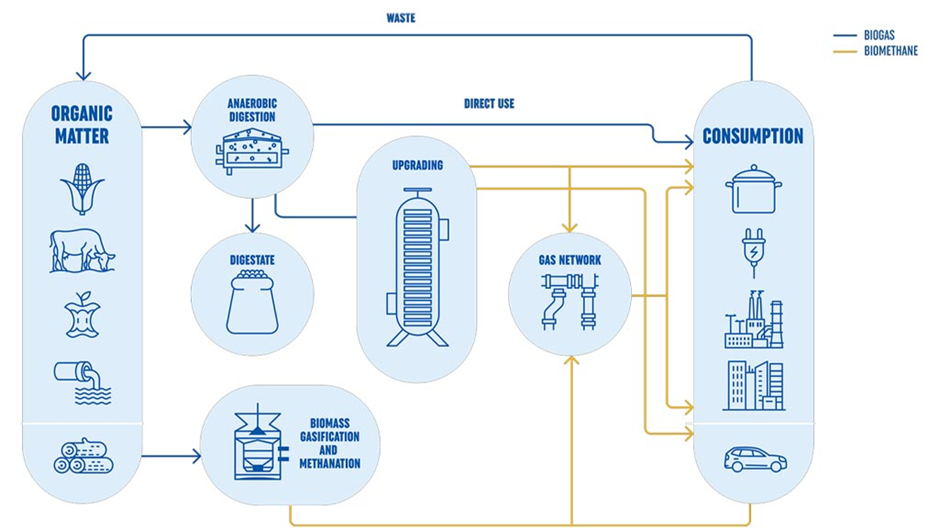
By capturing methane from landfills, wastewater treatment plants, agricultural residues, and food processing waste, biomethane prevents potent greenhouse gas emissions from escaping to the atmosphere while turning waste into a valuable energy resource. It represents a circular economy solution that simultaneously improves waste management, reduces emissions, and supports regional economic activity.
Internationally, renewable gas is increasingly recognised as an essential complement to electrification. Studies in the UK and the European Union have shown that attempting to electrify all heat and industrial demand would require prohibitively large investments in network capacity and storage. A balanced portfolio that includes renewable gases can achieve equivalent or greater emissions reductions at substantially lower system cost and risk.
Policy developments supporting biomethane
Several policy reforms introduced since 2023 have created a more coherent and credible framework for renewable gas in Australia:
- National Greenhouse and Energy Reporting (NGER) Scheme amendments (June 2025) now formally recognise biomethane and renewable hydrogen delivered through gas networks as having a lower (potentially zero) emissions factor when backed by eligible certificates. This allows industrial users to claim verified emissions reductions within their NGER inventories and, crucially, under the Safeguard Mechanism. For the first time, a manufacturer can purchase biomethane certificates equivalent to their gas consumption and legitimately report lower scope 1 emissions, mirroring the treatment of renewable electricity certificates.
- GreenPower Renewable Gas Certification, launched in late 2023, enables producers and consumers to trade verified renewable gas attributes. Under this program, biomethane injected into a gas network is issued Renewable Gas Guarantee of Origin (RGGO) certificates, which can be sold to consumers wishing to decarbonise their gas use voluntarily. The Jemena/Sydney Water Malabar Biomethane Project became the first facility to achieve GreenPower certification in March 2024, demonstrating that the voluntary market is already functional and scalable. This certification is currently only available for industrial and commercial renewable gas use and excludes households.
- Integration with the Guarantee of Origin (GO) Scheme is under way. The GO scheme will standardise emissions accounting across hydrogen and biomethane into the future, ensuring consistency in how these fuels are verified and traded. This will align our approach with international systems such as the EU’s Guarantees of Origin for renewable gases, enabling export recognition and compatibility with global supply chains.
- Safeguard Mechanism alignment and carbon market integrity are being enhanced through the interaction of these certification systems. As biomethane production scales, the NGER and GO frameworks ensure that emissions reductions are properly attributed and double-counting avoided. This strengthens investor and consumer confidence that renewable gas is a verifiable, tradable commodity capable of contributing directly to national targets.
Collectively, these reforms mark a decisive shift in the policy environment. They signal that renewable gas, particularly biomethane, is no longer peripheral to Australia’s net zero strategy, but an integral and certifiable part of the transition.
The importance of a National Bioenergy Feedstock Strategy
Questions addressed:
- What are the main barriers—commercial, logistical, regulatory, or environmental—to developing reliable and sustainable feedstock supply chains for domestic bioenergy production?
- Which feedstocks, or mix of feedstocks, should be prioritised for immediate deployment, and which require further research and development across the short, medium, and long term?
- How can government and industry support the utilisation of a diverse range of feedstocks, including resources like residues, woody biomass and other novel feedstocks?
- Besides those noted in the discussion paper, are there other key issues that should be considered in the development of a National Bioenergy Feedstock Strategy?
Despite positive progress in certification and accounting frameworks, the enabling framework for feedstocks has not kept pace with energy-sector policy reform. The National Bioenergy Feedstock Strategy Discussion Paper confines its focus to feedstocks derived from agriculture and forestry. While this approach reflects DAFF’s portfolio responsibilities, it inadvertently excludes the majority of Australia’s near-term, least-cost renewable gas potential — namely wastewater sludge, municipal organic waste, landfill gas and industrial food residues.
These sources represent around 70 per cent of Australia’s practical biomethane potential according to analysis by Blunomy for Energy Networks Australia[1], which found approximately 400 petajoules (PJ) per year of technically recoverable biomethane, of which over 250 PJ is derived from these waste-based streams. Excluding them risks fragmenting the policy architecture: a feedstock strategy anchored in agriculture and forestry will not reflect the real resource base that energy agencies must draw upon when designing renewable gas policy.
While APGA recognises that DAFF’s remit focuses on primary production, the strategy will feed directly into the Department of Climate Change, Energy, the Environment and Water’s (DCCEEW) work on renewable gas and low-carbon fuel policy. If the feedstock strategy omits waste-based and wastewater feedstocks, the resulting cross-government policy process may accidentally pre-determine an incomplete view of the available resource, leading to several unintended consequences:
- Omission of least-cost fuels: Waste and wastewater feedstocks typically produce biomethane for $10–15 per gigajoule, compared with $25–40 per gigajoule for agricultural residues or purpose-grown biomass. These are the very projects most capable of scaling quickly and delivering immediate emissions reductions.
- Reduced abatement efficiency: Excluding waste-based biomethane would force the transition toward higher-cost fuels, increasing the economy-wide cost of decarbonisation and delaying early abatement that is achievable this decade.
- Weakened investment certainty: Developers, councils and utilities pursuing waste-to-gas projects rely on clear signals their feedstocks are recognised in national planning. Exclusion from the strategy would make it harder for these projects to secure finance, even as government certification systems are being built to accommodate them.
These outcomes would make the energy transition harder and more expensive than necessary, contradicting the Government’s objective of achieving least-cost decarbonisation under the Future Made in Australia agenda.
A genuinely national feedstock strategy must therefore extend beyond sectoral boundaries. It should reflect the practical reality that Australia’s renewable gas industry will be built first on existing waste and wastewater resources — where collection networks, emissions benefits and infrastructure synergies already exist — before expanding to more capital-intensive agricultural and forestry pathways. Integrating these resources will not only align with DCCEEW’s policy development process but also ensure that Australia captures the full emissions, economic and circular-economy benefits of biomethane.
Undertake an updated east-coast feedstock audit
Questions addressed:
- Is sufficient feedstock data available to support the development of the strategy and inform investment in new bioenergy industries?
- What opportunities exist to improve feedstock supply chain efficiency and reduce costs?
- Besides those noted in the discussion paper, are there other key issues that should be considered in the development of a National Bioenergy Feedstock Strategy?
Australia’s ability to plan for renewable gas development depends on the quality and completeness of available feedstock data. At present, the most comprehensive resource, the Australian Biomass for Bioenergy Assessment (ABBA), was last comprehensively updated in 2017 and no longer reflects current conditions. While ABBA provided an important baseline for bioenergy resource mapping, the dataset now suffers from significant limitations that restrict its usefulness for contemporary policy and investment planning.
The challenges with the existing dataset can be summarised as follows:
- Outdated data inputs: Industrial activity, waste generation, and collection practices have shifted majorly in recent years. Reforms in recycling, population growth, and changes in agricultural production have altered the distribution and volume of feedstocks.
- Incomplete regional coverage: ABBA relied on voluntary data submissions from local governments and industry, leaving large data gaps across eastern Australia, particularly in Victoria, Queensland and New South Wales, where much of the nation’s wastewater and agricultural residue potential lies.
- Narrow feedstock classification: The assessment primarily captured agricultural and forestry residues, but did not systematically include municipal organic waste, landfill gas, or wastewater sludge, despite these representing the majority of near-term, low-cost biomethane potential.
- Limited integration with energy and emissions planning: The dataset was designed for agricultural resource assessment rather than energy system modelling. As a result, it is not aligned with existing infrastructure, emissions reporting frameworks, or renewable gas certification systems.
An updated east-coast audit would provide the foundation for a more accurate, regionally specific understanding of bioenergy potential. By aligning data collection with both DAFF and DCCEEW policy needs, a refreshed dataset could:
- Support least-cost deployment of renewable gas by identifying the most accessible and scalable waste and residue streams;
- Inform infrastructure and investment planning, particularly around wastewater treatment, food manufacturing, and agricultural processing hubs;
- Enable integrated emissions accounting across the NGER, Guarantee of Origin, and Safeguard Mechanism frameworks; and
- Increase investor confidence by providing transparent and contemporary data on feedstock quality, volume, and location.
Without a refreshed and integrated dataset, Australia risks designing bioenergy policy on outdated assumptions. A modernised ABBA 2.0 should build upon the existing framework but extend its scope to include waste and wastewater sources, regional collection infrastructure, and links to industrial precincts and gas networks. Such an update would provide the foundation needed for a coherent, whole-of-economy bioenergy and renewable gas strategy, ensuring investment and policy decisions reflect the true scale and distribution of available resources.
Conclusion
The development of a National Bioenergy Feedstock Strategy is an exciting and timely initiative.
It represents a major step toward unlocking Australia’s renewable gas potential and building the foundations for a circular, low-emissions economy.
APGA strongly supports this process and encourages the Department to consider the recommendations outlined in this submission to maximise the strategy’s effectiveness. Expanding the scope to include all waste-derived feedstocks, strengthening cross-government coordination, and commissioning an updated feedstock audit will ensure the strategy is comprehensive, data-driven, and capable of delivering real outcomes for industry, investors, and the broader economy.
APGA welcomes the opportunity to further collaborate with the Department in developing and implementing the strategy, and to share industry insights that can help shape a practical, enduring framework for Australia’s renewable gas future.
[1] Blunomy, 2025, Biomethane Opportunities to Decarbonise Australian Industry: Converting waste into grid-injectable biomethane, prepared for Energy Networks Australia, https://www.energynetworks.com.au/assets/uploads/Blunomy-%E2%80%93-2025-%E2%80%93-Biomethane-Opportunities-to-Decarbonise-Australian-Industry.pdf