
Executive Summary
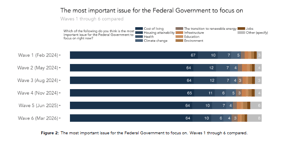
Australia’s national sentiment continues to be dominated by cost-of-living pressures. Notably, petrol prices have emerged as a rapidly growing issue, reflecting heightened sensitivity to everyday expenses. While electricity costs remain a consistent concern, their importance varies across demographics, with increasing concern among Labor voters and those in provincial areas.
Public evaluation of the federal government’s performance—particularly on the energy transition—remains negative overall, though perceptions are increasingly polarised along political lines. Lowering energy costs is clearly the top voter priority, far outweighing emissions reduction or system reliability. At the same time, confidence in the government’s ability to meet its 2030 emissions targets remains low, underscoring a persistent credibility gap.
Gas continues to hold a critical role in Australia’s energy transition, with over 70% of voters endorsing its inclusion. Support for increased gas production and government intervention to stabilise prices is strong and bipartisan, although opposition is gradually increasing and attitudes are becoming more entrenched. Policies such as domestic gas reservation enjoy near-universal support, indicating clear public appetite for energy security measures. Support for gas is rising across all regions and demographics, reinforcing its perceived importance as a stabilising force in the transition.
Despite ongoing policy efforts, most Australians expect the transition to renewable energy to increase costs in the near term, with limited willingness to absorb higher expenses.
Overall, the findings highlight a complex policy environment where economic pressures, scepticism about affordability, and strong support for gas shape public expectations of the energy transition.